The Somali Monitor
Washington Extends AUSSOM Support: What Does This Mean for Somalia?
The United States' decision to extend support for AUSSOM and UNSOS for another year offers Somalia temporary relief from a looming security financing crisis. However, the reversal also exposes deeper questions about the sustainability of international military assistance, the readiness of Somali security forces and the political challenges surrounding the country's transition to national security ownership.
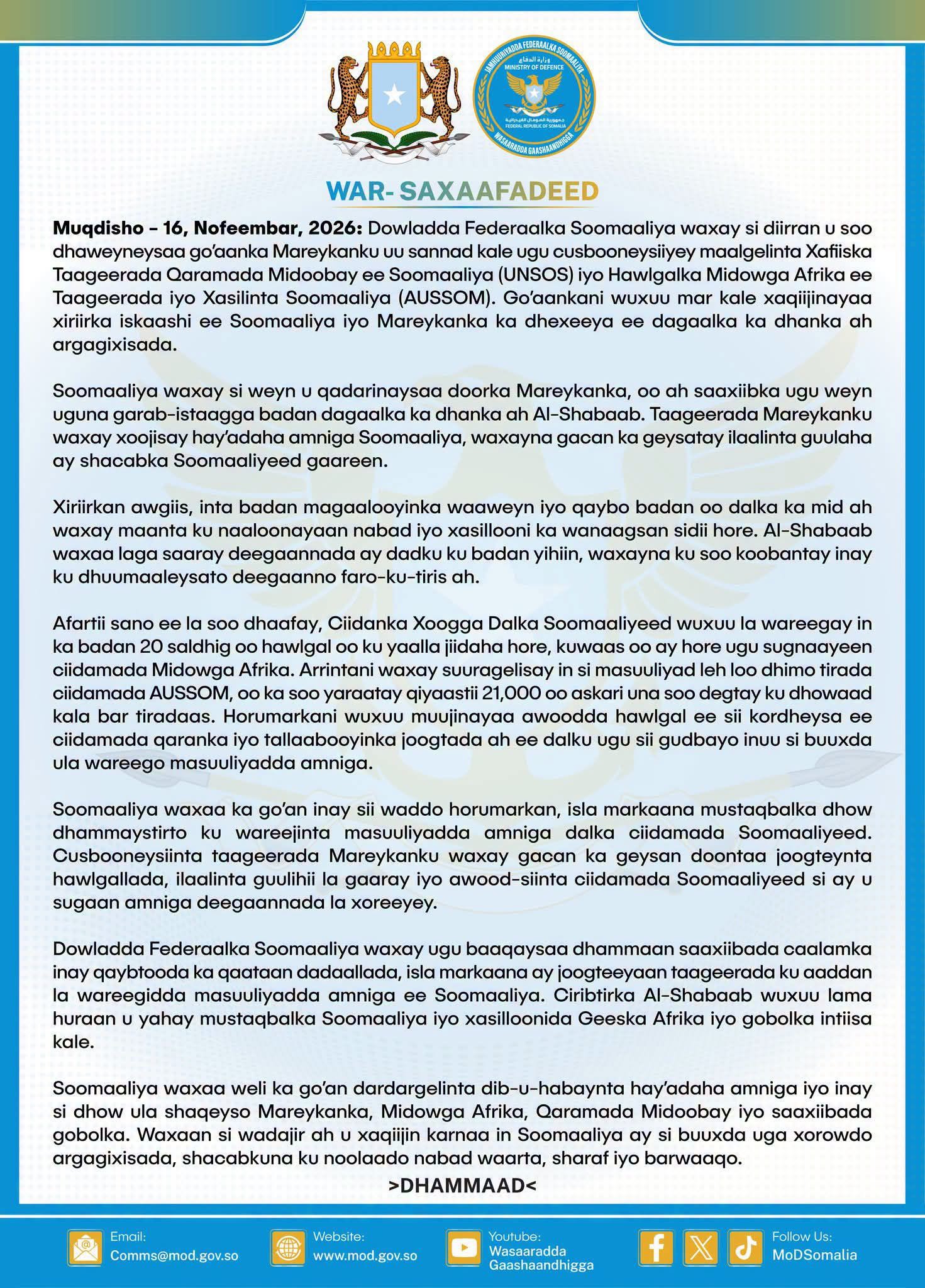
Somali Press Release, 16 Nov 2026
MOGADISHU — November 16, 2026
The Federal Government of Somalia has welcomed Washington's decision to renew support for the United Nations Support Office in Somalia (UNSOS) and the African Union Support and Stabilization Mission in Somalia (AUSSOM) for another year, describing it as a reaffirmation of the strategic partnership between the two countries in combating Al-Shabaab. The announcement, reported by Agence France-Presse (AFP) on November 16, represents a significant shift in American policy following months of uncertainty over the future of international security assistance in Somalia. While Mogadishu has portrayed the decision as recognition of progress in rebuilding national security institutions, its broader significance lies in Washington's apparent acknowledgement that an abrupt withdrawal of support could jeopardize security gains and undermine Somalia's ongoing transition.
The reversal follows a particularly consequential development in September, when the United States informed the African Union Commission of its intention to discontinue support for UNSOS after the expiration of AUSSOM's existing authorization on December 31, 2026. Washington had instead proposed a further 12-month period to wind down the UN support operation, raising concerns among African Union troop-contributing countries about the consequences of withdrawing essential logistical assistance before Somali forces were sufficiently prepared to assume full operational responsibility. The latest decision therefore provides temporary reassurance to African partners while demonstrating the continuing importance of Somalia within American counterterrorism and regional security calculations.
However, Washington's renewed commitment should not be interpreted as an indefinite security guarantee. According to Somalia Today, citing a US State Department spokesperson, the United States considers continued support necessary to contain threats that could destabilize Somalia and the wider region, while maintaining its expectation that Somali authorities and international partners progressively assume greater responsibility for financing and sustaining security operations. This distinction suggests that Washington's policy adjustment is intended to prevent an immediate operational vacuum rather than abandon its longer-term objective of reducing dependence on externally financed peace support operations.
The financial vulnerability of AUSSOM provides important context for understanding the decision. Established in January 2025 as the successor to the African Union Transition Mission in Somalia (ATMIS), AUSSOM inherited responsibility for supporting Somali security forces, counterterrorism operations and the gradual transfer of security responsibilities to national institutions. Yet the mission has faced persistent financing challenges, including a reported $38.5 million funding shortfall against its $154.7 million operational budget for 2025. These constraints have complicated troop deployment planning and raised questions about the sustainability of the mission. During their July summit in Kampala, African Union troop-contributing countries called for an additional 18 to 24 months of predictable international support, arguing that a responsible transition required adequate financing, operational readiness and clearly defined withdrawal benchmarks.
The significance of UNSOS is particularly important because its contribution extends beyond direct financial assistance. The UN support office provides essential logistical services, including transportation, fuel, rations, medical evacuation, engineering and operational supplies that sustain both African Union and Somali security forces. According to the UN Secretary-General's October 2026 report, UNSOS was supporting approximately 11,911 AUSSOM personnel across 49 locations, alongside arrangements covering up to 20,900 Somali security personnel. Earlier disruptions to fuel and ration deliveries illustrated the vulnerability of military operations to financing shortages. Consequently, the continuation of American support has implications not only for African Union deployments but also for the operational effectiveness of Somali forces that remain dependent on international logistical assistance.
For the Federal Government, the announcement also offers an opportunity to reinforce its narrative of progress toward national security ownership. In its official statement, Mogadishu reported that the Somali National Army had assumed control of more than 20 forward operating bases previously occupied by African Union forces over the past four years. It further attributed the reduction in African Union troop strength, from approximately 21,000 personnel to nearly half that number, to the growing operational capacity of national forces. The government maintained that most major cities and substantial parts of the country now enjoy improved security, while Al-Shabaab has been pushed out of densely populated areas. These assertions form part of Mogadishu's broader argument that Somalia is progressively developing the institutional and military capabilities required to assume responsibility for its own security.
Nevertheless, the government's assessment requires careful examination against the continuing operational realities. Although Somali forces have expanded their responsibilities and international troop numbers have declined, the transfer of military bases does not necessarily demonstrate the capacity to independently sustain territorial control. Effective security ownership requires reliable logistics, functioning command structures, predictable financing, intelligence capabilities and the ability to protect civilian populations after military operations conclude. Moreover, the UN Secretary-General's October report continued to identify Al-Shabaab as the principal security threat across southern and central Somalia, documenting persistent insurgent activity and attacks against security positions. The contrast between official claims of territorial progress and continuing insurgent operations underscores the distinction between military advances and durable stabilization.
The decision also highlights unresolved disagreements over the international financing architecture for African Union peace operations. Somalia and several international partners have supported exploring the framework established under UN Security Council Resolution 2719, which allows for the potential use of UN-assessed contributions to finance eligible African Union-led peace support operations. Washington, however, has opposed applying this arrangement to AUSSOM, while other partners have emphasized broader financial burden-sharing. These disagreements illustrate the structural challenge confronting Somalia's security transition: international actors broadly recognize the importance of preventing a security vacuum, but remain divided over who should finance the mission, for how long and under what conditions. The latest American extension provides temporary breathing space without resolving these fundamental questions.
Equally important is the relationship between Somalia's security transition and its unresolved domestic political divisions. Continuing disagreements between the Federal Government and some federal member states over constitutional arrangements, electoral processes and political authority have complicated national coordination. These tensions have implications for security operations, particularly where effective counterterrorism efforts require cooperation between federal institutions, regional administrations and local communities. International military assistance can strengthen operational capabilities, but it cannot independently resolve political disputes, establish effective civilian administration or guarantee public confidence in state institutions. Without a coherent national political framework, progress in security-sector reform risks remaining fragmented and vulnerable to changing political circumstances.
The coming year therefore presents both an opportunity and a test for Somalia's leadership and international partners. The extension creates space to strengthen national command structures, improve coordination with federal member states, develop sustainable financing mechanisms and establish realistic benchmarks for transferring operational responsibilities. Equally essential is the integration of military operations with civilian stabilization, local governance, reconciliation and basic service delivery in areas recovered from Al-Shabaab. Experience across Somalia has repeatedly demonstrated that the removal of insurgents from territory does not automatically translate into lasting government authority unless communities experience improved security, accountable administration and tangible peace dividends.
Ultimately, Washington's reversal provides Somalia with additional time, but not a permanent solution to its security challenges. The decision reflects the continuing strategic importance of preventing Al-Shabaab from exploiting a premature international withdrawal, while reinforcing expectations that Somalia must progressively assume greater responsibility for its security. Whether this extension becomes a meaningful step toward national security ownership or another temporary arrangement sustained by external assistance will depend on the progress achieved during the coming year. The central challenge is no longer simply how many international troops remain in Somalia, but whether Somali institutions can develop the political cohesion, operational capacity and financial sustainability necessary to protect the population and preserve security gains independently