The Somali Monitor
Sweden–Somalia Informal Deportation Deal: What Is the Prime Minister’s Office’s Role?
Sweden’s informal deportation-related arrangement with Somalia, acknowledged in Swedish parliamentary findings, raises serious questions about the growing intersection of migration enforcement, development assistance and government accountability. This reporting examines the SEK 100 million aid arrangement, the involvement of Somalia’s Office of the Prime Minister, and the wider role of European-funded migration and reintegration programmes. Drawing on Swedish parliamentary records and investigative reporting, it explores concerns over financial transparency, institutional accountability and the protection of Somali nationals facing forced returns, particularly amid Somalia’s continuing insecurity and the obligations of both governments under international human rights law.
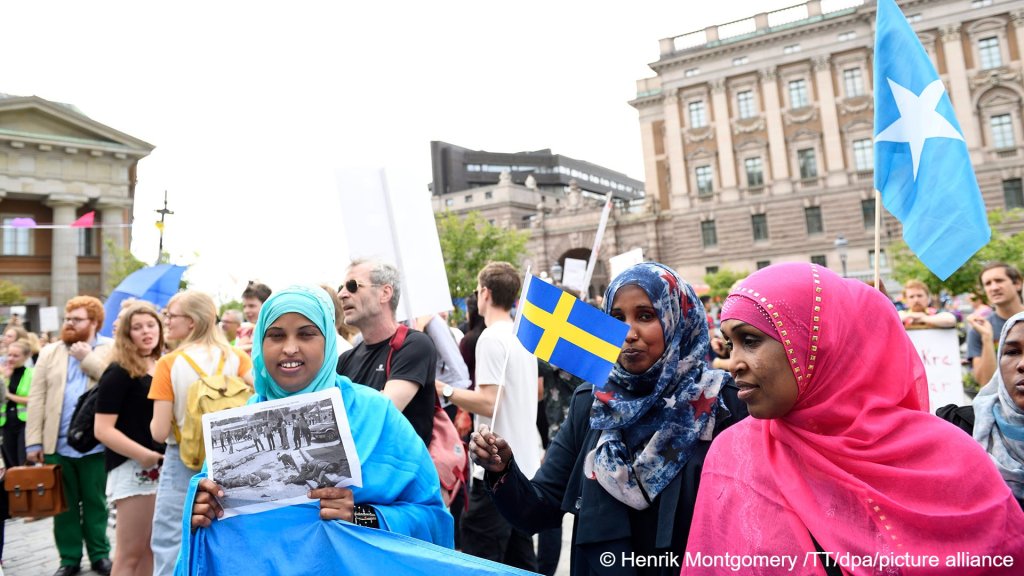
Sweden's efforts to increase deportations of those Somalis who fled the country for different reasons including protection, have exposed an increasingly consequential relationship between migration enforcement, development assistance and Somalia's central government institutions. This is not just an allegation; Sweden’s official development strategy for migration, returns and voluntary repatriation (2024-2028) explicitly allows linking foreign aid development to cooperation with Somalia on readmission while a 2026 Swedish expert report on migration and development identifies funding channels through United Nation’s Development Programme (UNDP) for interventions involving Somalia’s Prime Minister Office alongside assurances of cooperation of the return of Somali nationals. The Swedish Parliament further identifies Somalia’s OPM as its principle implementing partners, with resources allocated through UNDP – raising concerns about the independence of development priorities, and Somalia’s role involving foreign-funded deportations linked to negotiated returns of Somalis back to Somalia. This further complicates Somali governments institutional accountability, transparency of funding arrangements, aid related political-economy, political influences, interests and processes shaping bilateral such assistance.
The origins of the Sweden-Somalia deportation saga can be traced to diplomatic negotiations that took place between October-December 2023, when Stockholm, through its ambassador Joachim Waern sought Somalia’s stronger cooperation in accepting Somali nationals facing deportations. According to Swedish Parliaments 2026 investigation, Sweden Ambassador received instructions on December 4th, 2023, ahead of discussions with the office of Somalia’s prime minster, identifying potential development initiatives alongside cooperation on the return of Somali nationals, and in exchange for earmarked funds for deportations. Three days later, the Ambassador informed Stockholm, in an email titled “Uppgörelse klar” (“agreement reached”) which meant that an informal common understanding on deportations has been established. A working document accompanied the communications alongside a statement from Somalia’s Office of the Prime Minister announcing a renewed partnership that included Swedish support for the Somali Italian “Towards Peace and Stability in Somali fund.
Even while the two leaders; PM Hmaza and Ambassador Joachim Waern, communicated to the respective audiences in Mogadisho and Stockholm respectively, the messages were different as noted by the Swedish investigation team. Likewise, a senior Swedish official explained to parliament that the ambassador sought development initiatives better aligned with Somali leadership priorities, while Somalia would pursue Sweden's priority of accepting returning nationals. This establishes reciprocity as part of the political understanding, even though the arrangement was not legally binding. For Mogadishu, it was about the informally negotiated money and for Stockholm, the priority was the deportation of Somali nationals back to Somalia. And based on available documents read by The Somali Monitor, including the Swedish Parliament’s 2026 investigation; Sweden had committed to Somalia 100 million Swedish kroner (SEK 100 million) in line with its migration cooperation ambitions and overseas development assistance. The project financing clause has two separate contributions; SEK 40 million channeled through the World Bank-administered fund in April 2024 to support state-building, and another 40 million Swedish kronor under UNDP in June 2025 to support the OPM office as the implementing partner for the deportation operations and coordination with other involving government institutions including the National Commission for Refugees and IDPs (NCRI). The Swedish parliament evidence further confirms the OPM’s intended implementation, program resources and funding relations with UNDP but does not establish the precise amount ultimately transferred to the OPM office. But why should resource contributions formally designated for development and state-building priorities, be rather financing deportations of Somali nationals, spearheaded by the Office of the Prime Minister?
More striking, the March 2026 report by Sweden's Expert Group for Aid Studies (EBA), on pages 232–233, explicitly identifies Swedish financing channelled through UNDP to Somalia's Office of the Prime Minister alongside assurances concerning the readmission of Somali nationals, despite the absence of return-related objectives in the programme's formal development framework. The report raises concerns about transparency, corruption risks and the diversion of development resources from other priorities. This finding is significant because it shifts the scrutiny beyond whether UNDP directly financed deportations to whether development assistance was politically mobilised to secure Somalia's cooperation in accepting deported nationals. It also raises a broader accountability question: whose priorities ultimately determine the allocation of foreign assistance—Somalia's development needs or the migration enforcement interests of its international partners?
Somalia’s migration statics report -second edition (2025) written by the Somali government also reveals an important aspect of the deportation dynamics between Somalia and Sweden. According to Somalia National Bureau Statistics, Table 4.4 Page 17, records a total of 282 migrant returns from selected European countries between 2020 and 2024, including 88 from Germany, 42 from Belgium and 34 from Switzerland. Notably, Sweden was absent from the countries-of-return statistics. This comes at the backdrop of Sveriges Radio reporting on Mrach 17 2025, citing Swedish national border police, that enforced deportations to Somalia increased from six (6) in 2023 to twenty-four (24) in 2024, which in another reporting by SVT report dated December 13 2025, citing Swedish authorities, confirms twenty-nine (29) enforced deportations, rather than the 24 reported earlier by Sveriges Radio. Al though these discrepancies does not establish that deportations were unregistered, it highlights limitation in the completeness and comparability of publically available migration data. Against the backdrop of Sweden use of development assistance to encourage cooperation on migration returns, the omission of Sweden as a country of countries -of- return or even the absence of clearly disaggregated statistics raises a broader accountability question.
Sweden's expanding institutional engagement with Somalia extends beyond the controversial SEK 100 million development-financing arrangement associated with the two countries' 2023 understanding on readmission. Public records identify approximately SEK 118 million in four distinct Swedish commitments and funding arrangements covering World Bank state-building support, UNDP governance assistance, IOM migration-coordination advisers and the Swedish Migration Agency's CapSom programme. Separately, a GIZ programme overview identifies a €4.6 million SIDA contribution within a wider €22.6 million European migration-management and reintegration framework. The institutional network includes Somalia's Office of the Prime Minister, the National Coordination Mechanism on Migration, the National Commission for Refugees and IDPs, and international agencies responsible for implementation and oversight.
According to different sources, there are active on-going deportation funded programs between Somalia and Sweden as Sweden's July 2026 decision to finance six technical advisers within the National Coordination Mechanism, through an IOM initiative developed with the Office of the Prime Minister, provides a particularly direct illustration of this relationship. The Swedish-supported UNDP governance programme has also advertised eight strategic and technical advisory positions within the OPM, although their recruitment and financing outcomes require verification, and could not be well established by the Somali Monitor. These arrangements illustrate the growing role of external financing in supporting Somali government capacity, but they also expose an important accountability gap: publicly available programme announcements do not provide a consolidated record of advisers employed, institutional expenditure, salary costs or independently verified reintegration outcomes. Assessing the value of Sweden's migration-related development assistance therefore requires examining not only the funds committed and institutions supported, but also how those resources are distributed between administrative capacity, direct returnee assistance and sustainable reintegration.
The Sweden–Somalia deportation arrangement has also attracted scrutiny beyond parliamentary proceedings and investigative journalism. Sweden’s Centre for Asylum Rights examined the Swedish government's policy of linking development assistance to cooperation on migration returns, specifically referencing the reported SEK 100 million arrangement with Somalia. The agreement has also been examined in the academic study The Whole-of-Government Turn in Swedish Return Policy: The Reconfiguration of Institutions, Actors, and Ethics by Zoran Slavnic, Branka Likic-Brboric and Aida Ibricevic, which situates the arrangement within Sweden's broader shift toward using development assistance, diplomacy and intergovernmental cooperation to advance migration enforcement. Together, these analyses raise wider questions about transparency, the political conditions attached to development financing, and the responsibilities of both Swedish and Somali authorities when resources intended for development become linked to the return of deported nationals.
The Somali Monitor has this November 2026 obtained information concerning a reported plan to deport Somali nationals, including women, from Sweden and other Nordic countries back to Somalia, raising serious concerns about forced returns amid persistent insecurity, armed conflict and limited state protection. These concerns are longstanding. Amnesty International (2014) identified Sweden and other Nordic countries among those attempting forced returns to Somalia, warning of potential violations of international law, while the UN Human Rights Committee's D.A.M. v. Sweden (2020) proceedings underscored the importance of assessing individual protection risks before removal. More recently, the European Union Agency for Asylum (2026) documented continuing violence, displacement and insecurity across Somalia. These conditions raise serious questions under the international legal principle of non-refoulement, requiring European governments to assess individual protection risks before deportation, while placing corresponding responsibilities on the Somali government to protect the rights, safety and dignity of returning nationals. Although their legal obligations differ, both sides must ensure that migration agreements, deportation arrangements and reintegration programmes do not facilitate returns that expose individuals to persecution, torture or other serious harm prohibited under international law. Somalia's cooperation in receiving deportees must therefore be matched by credible protection safeguards, institutional accountability and sustainable reintegration measures.
info@thesomalimonitor.com