
The Somali Monitor
Somalia’s Judicial Crisis Goes Regional as East African Legal Bodies Defend Chief Justice Bashe
Regional legal organizations have entered Somalia’s escalating constitutional confrontation, raising questions about judicial independence, executive authority and the credibility of the country’s constitutional transition amid growing electoral uncertainty.
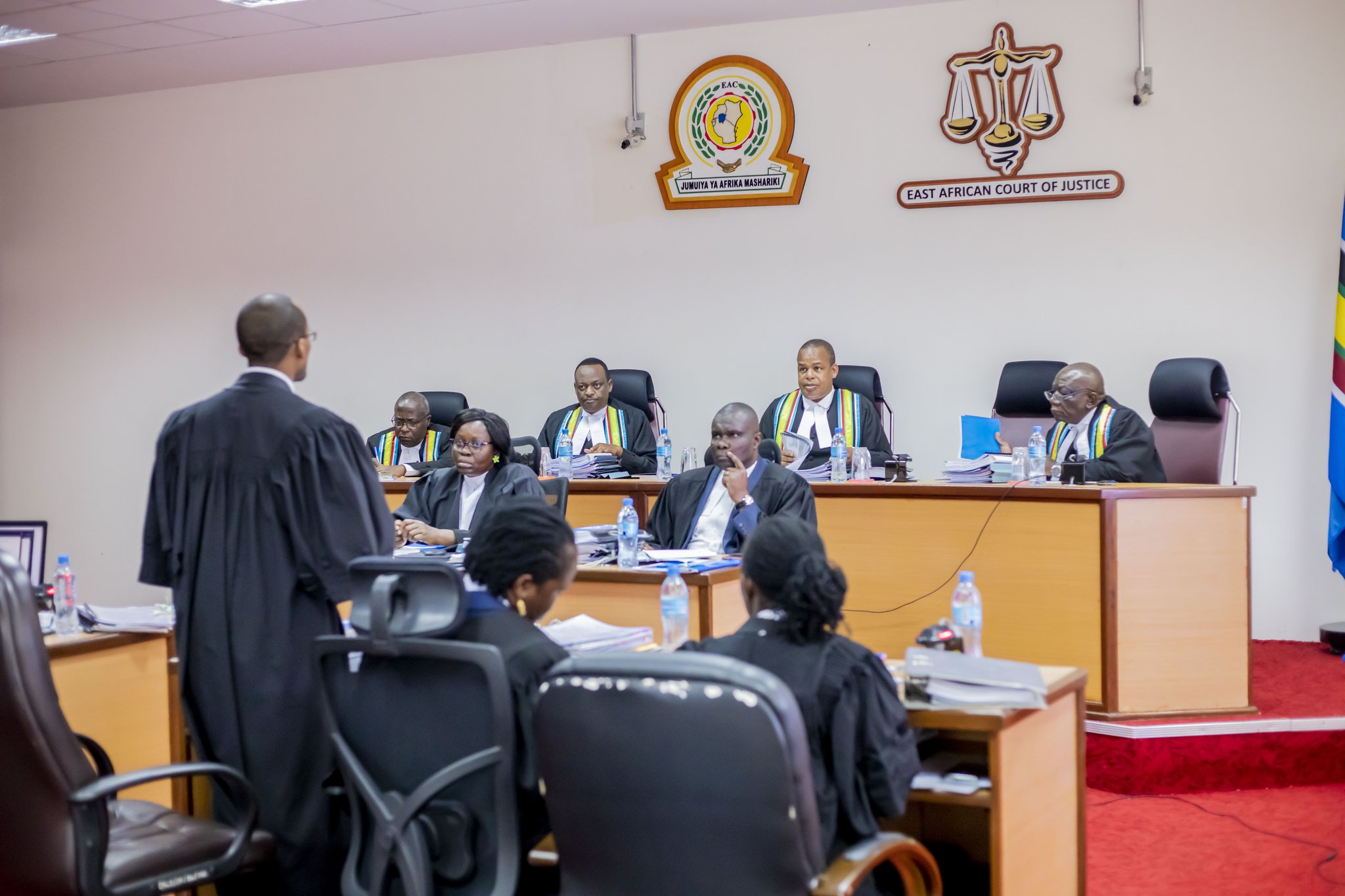
Photo of East African Court of Justice, 2024
MOGADISHU — November 10, 2026
Somalia’s deepening constitutional crisis has taken on a regional dimension following interventions by the East Africa Law Society (EALS) and the Africa Judges and Jurists Forum (AJJF), which have publicly challenged the reported dismissal of Supreme Court Chief Justice Bashe Yusuf Ahmed. What began as a dispute over President Hassan Sheikh Mohamud’s authority to remove the country’s highest judicial official has developed into a broader confrontation over constitutional supremacy, presidential term limits and the independence of Somalia’s judiciary.
The controversy followed President Hassan Sheikh’s decision in early November to replace Bashe with Ibrahim Idle Suleiman, amid judicial proceedings challenging the legality of constitutional amendments and the duration of federal institutional mandates. The Supreme Court subsequently rejected Bashe’s removal and issued a far-reaching judgment questioning the continued constitutional authority of the president and other federal institutions. The federal government has disputed the court’s findings, creating competing claims of constitutional legitimacy at a particularly sensitive moment in Somalia’s electoral transition.
At the centre of the confrontation is a fundamental institutional question: whether Somalia’s judiciary can exercise independent constitutional oversight when its decisions directly challenge the political authority of the executive. Although the provisional constitutional framework provides for separation of powers and judicial independence, the incomplete establishment of constitutional institutions and persistent political interference have left the judiciary vulnerable to disputes over its authority and enforcement powers.
The intervention of regional legal organizations introduces a significant new dimension. In a statement dated November 10, the East Africa Law Society reportedly condemned interference with Somalia’s Supreme Court, warning that threats against judges and disregard for judicial decisions undermine constitutional governance and the rule of law. The organization called for the protection of judicial officials, restoration of their security and freedom of movement, and respect for constitutional processes. Chief Justice Bashe publicly welcomed the intervention, thanking EALS President Ramadhan M. Abubakar and emphasizing that the dispute concerns constitutional supremacy rather than his personal position.
Similarly, the Africa Judges and Jurists Forum urged President Hassan Sheikh to reverse the disputed dismissal, refrain from interfering with judicial independence and guarantee Bashe’s personal security. These interventions suggest that Somalia’s constitutional confrontation is attracting scrutiny beyond its domestic political divisions, particularly among regional legal institutions concerned about executive interference with judicial authority.
The regional attention is especially significant given Bashe’s previous engagement with East African judicial institutions. In July 2024, he visited the East African Court of Justice in Arusha, Tanzania, where he met Judge President Nestor Kayobera to discuss judicial cooperation, institutional capacity-building and the strengthening of judicial independence. Bashe described the regional court as a model for promoting justice and the rule of law, reflecting Somalia’s broader ambition to align its judicial institutions with regional standards following its accession to the East African Community. Bashe's participation in regional judicial forums and engagement with East African judges and magistrates further established institutional relationships that have acquired new relevance during the current confrontation. However, an important distinction remains: EALS and AJJF are professional legal organizations whose statements carry institutional and reputational influence, while the East African Court of Justice is a treaty-based judicial body. Neither organization’s intervention constitutes a binding judicial determination, and the EACJ has not been shown to have issued a ruling on Somalia’s current domestic constitutional dispute.
The immediate political origins of the crisis can be traced to a constitutional petition filed by former President Sheikh Sharif Ahmed on October 11, challenging constitutional amendments and their implications for the mandates of Somalia’s federal institutions. The petition placed the Supreme Court at the centre of an increasingly contested constitutional transition, particularly over whether amendments extending institutional terms could legally apply to officials already holding office. In its reported November 5 ruling, the Supreme Court concluded that constitutional amendments extending institutional mandates from four to five years could not automatically be applied retrospectively. On that basis, it determined that President Hassan Sheikh’s constitutional mandate had expired in May 2026 and called for an accelerated electoral process, including political agreement on an electoral framework and elections within 90 days.
The judgment carried substantial political consequences. The federal government has maintained that constitutional reforms permit the current administration to continue until May 2027, while opposition leaders have challenged the legitimacy of extending existing mandates without broader political agreement. The Attorney General’s Office disputed the court’s jurisdiction, composition and legal conclusions, demonstrating that the confrontation involves not only presidential authority but also competing interpretations of the judiciary’s constitutional powers. These disagreements are complicated by Somalia’s failure to fully operationalize the separate Constitutional Court envisaged under its constitutional framework. The Supreme Court’s exercise of constitutional jurisdiction has consequently become part of the dispute itself, exposing a longstanding institutional weakness in Somalia’s constitutional architecture.
Nevertheless, disagreement over judicial jurisdiction does not automatically justify the removal or intimidation of judges. The legality of Bashe’s dismissal and the validity of the court’s constitutional judgment are related but distinct questions, each requiring resolution through recognized legal procedures. The confrontation intensified following reports that security personnel were deployed around the Supreme Court and that Bashe and other judges faced threats and restrictions. Bashe publicly alleged that hundreds of security personnel and armed vehicles had been positioned around the court, stating that he no longer felt safe in Mogadishu. While the precise circumstances of these deployments require independent verification, the allegations raise serious concerns about whether judicial officials can exercise their constitutional responsibilities without executive pressure.
President Hassan Sheikh subsequently proceeded with the appointment of Ibrahim Idle Suleiman, who was sworn in on November 7 despite the continuing dispute. This created competing claims to the leadership of Somalia’s highest judicial institution and highlighted the imbalance between judicial authority and executive control over state security and administrative structures. The broader political implications are considerable. The confrontation is unfolding as Somalia approaches a contested electoral transition, with the federal government advancing constitutional reforms and a direct-election framework opposed by influential political actors, including former presidents and the Puntland and Jubbaland administrations. The Supreme Court’s ruling, if implemented, could substantially alter the administration’s electoral timetable and require an accelerated political settlement.
For opposition groups, the judgment provides a potentially powerful constitutional argument against the government’s continued mandate. For the presidency, accepting the ruling could significantly weaken its political position and require renegotiating the transition under conditions less favourable to the administration. The resulting confrontation therefore reflects the intersection of constitutional interpretation, institutional independence and political calculations surrounding the next federal elections. Yet the judiciary’s independence must not become another instrument of political competition. Judicial decisions require protection from executive interference, but they must also remain subject to legitimate legal scrutiny. Neither the government nor the opposition should be permitted to treat the courts as institutions whose authority depends on whether their decisions advance particular political interests.
Somalia’s membership in the East African Community adds another layer of significance. Regional integration places increasing emphasis on predictable legal institutions, accountability and adherence to the rule of law. Although the EACJ does not automatically possess appellate authority over Somalia’s Supreme Court, the EAC framework provides an institutional environment in which serious concerns about constitutional governance can attract wider regional attention. For President Hassan Sheikh’s administration, the reputational implications could become increasingly consequential. Somalia has sought international recognition for rebuilding public institutions, advancing constitutional reform and strengthening governance after decades of state fragility. Allegations of judicial intimidation, contested dismissals and executive rejection of adverse court decisions risk undermining that institutional narrative.
The crisis also presents a test for Somalia’s international partners, particularly those supporting constitutional reform, justice-sector development and electoral governance. Their response will reveal whether judicial independence is treated as a substantive requirement of state-building or merely as a principle invoked when politically convenient. Three possible trajectories now emerge. A negotiated institutional settlement could address the disputed appointment, clarify constitutional jurisdiction and establish guarantees for judicial independence. Alternatively, continued executive resistance and competing claims to judicial leadership could deepen institutional fragmentation, leaving uncertainty over the authority of future Supreme Court decisions. A third possibility is that the dispute becomes incorporated into wider electoral negotiations, producing a political compromise without necessarily resolving the underlying constitutional weaknesses.
Ultimately, the regional interventions cannot substitute for functioning domestic institutions or enforce Somalia’s constitutional judgments. Their significance lies in reinforcing the principle that judicial independence is not simply a domestic political preference but a fundamental requirement of constitutional governance. The confrontation surrounding Chief Justice Bashe Yusuf Ahmed exposes a contradiction at the heart of Somalia’s state-building process: successive administrations have pursued constitutional reforms and institutional reconstruction without fully consolidating the independent mechanisms necessary to restrain executive power.
The central danger is that a dispute over the leadership of the Supreme Court could establish a precedent in which constitutional authority is determined less by independent legal institutions than by the political actors controlling the machinery of the state. As East African legal organizations increasingly scrutinize the confrontation, Somalia’s judicial crisis has moved beyond a contest between the president and the Chief Justice. It has become a defining test of whether the country’s constitutional transition can produce genuine institutional accountability, independent judicial authority and meaningful limits on executive power.