The Somali Monitor
Somalia’s November 14 Political Talks: What Lies Ahead?
Somalia’s November 14 political talks unfold amid a deepening constitutional crisis, divided opposition and competing political initiatives in Mogadishu and reportedly in Garowe. While Farmaajo and Sharmarke appear open to dialogue, Deni and Madobe maintain a firmer position, raising questions about whether international mediation can bridge political divisions, restore electoral consensus and prevent further institutional confrontation.
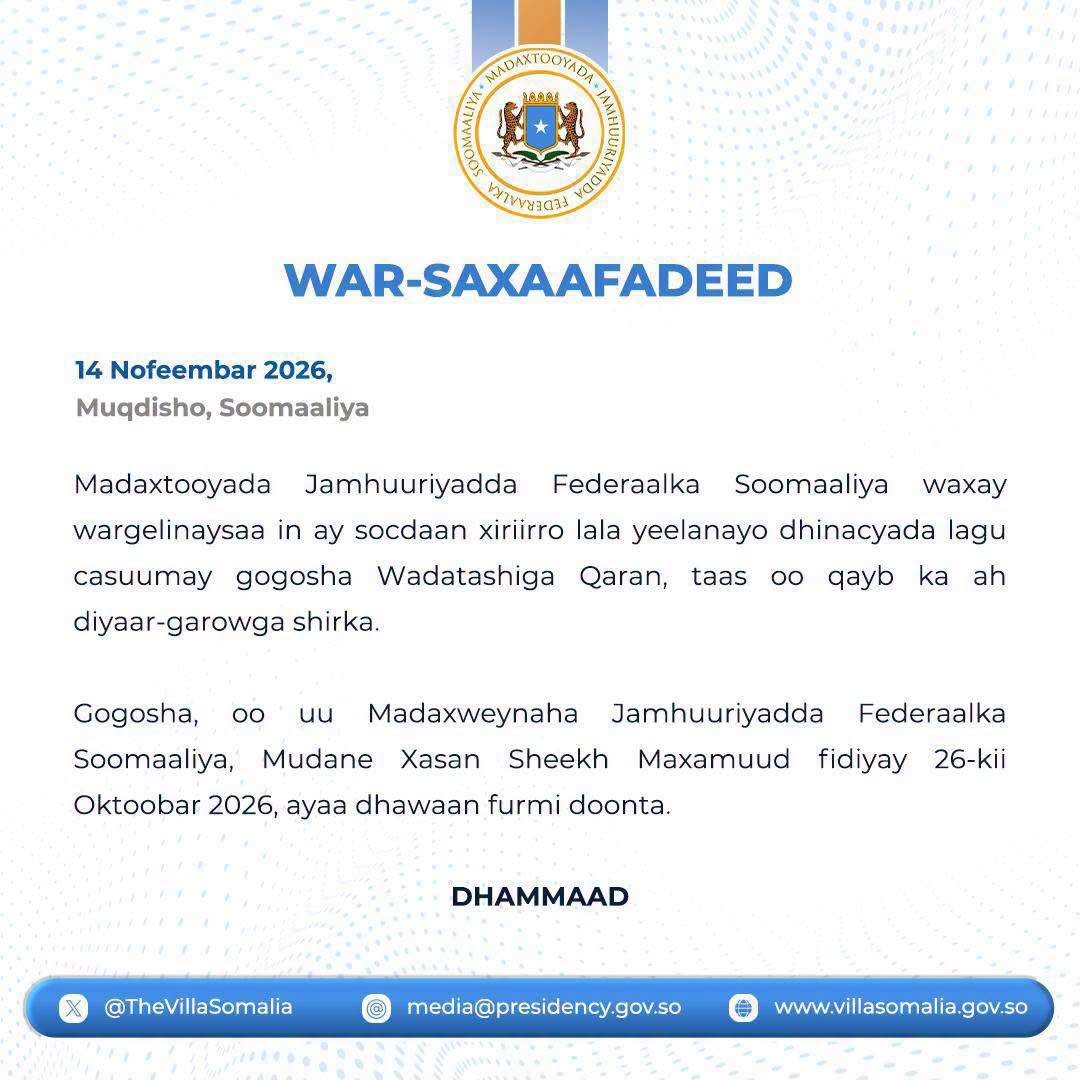
Villa Somali Communique, 14 Nov 26
Somalia enters a critical phase of its constitutional and electoral crisis as President Hassan Sheikh Mohamud convenes national consultations in Mogadishu from November 14–18, amid competing political initiatives, divisions within the opposition and growing international diplomatic engagement. While Puntland President Said Abdullahi Deni and Jubaland President Ahmed Mohamed Islam Madobe are reportedly coordinating a parallel political initiative in Garowe, former President Mohamed Abdullahi Farmaajo and former Prime Minister Omar Abdirashid Ali Sharmarke appear more receptive to engagement with the presidency. These developments reveal an increasingly complex political landscape in which the prospects for a national settlement may depend as much on informal negotiations and opposition calculations as on the formal proceedings in Mogadishu.
The Mogadishu consultations represent the Federal Government's latest attempt to resolve an electoral dispute that has evolved into a broader confrontation over presidential authority, judicial independence and Somalia's federal settlement. Invitations have reportedly been extended to the Nabad iyo Nolol Party, the Somali Future Council, the National Unity Forum and civil society representatives. However, the anticipated absence of Puntland and Jubaland threatens to undermine the political credibility and nationwide acceptance of any agreement. The central question is whether the forum will provide genuine space for negotiating contested constitutional and electoral arrangements or become another consultation intended to secure endorsement of decisions already taken by the presidency. More importantly, the emerging differences within the opposition suggest that the negotiations could develop along several interconnected tracks, with some leaders pursuing direct engagement while others seek stronger collective guarantees before entering talks.
The immediate dispute originates in the constitutional amendments approved in March 2026, extending presidential and parliamentary terms from four to five years. The Federal Government interprets these changes as authorizing the continuation of existing institutions into 2027, with parliamentary elections scheduled for April 15 and the presidential election for May 15. Opposition leaders reject the retrospective application of the amendments, maintaining that Hassan Sheikh's original mandate expired on May 15, 2026. The confrontation intensified following the reported November 5 Supreme Court ruling declaring the existing mandates expired, restricting the government's authority to caretaker functions and directing political stakeholders to agree on an electoral framework within 30 days. The disputed removal of Chief Justice Baashe Yusuf Ahmed and the government's rejection of the ruling's effect have further complicated the crisis, transforming an electoral disagreement into a confrontation over constitutional authority and the separation of powers. While the administration's commitment to one-person, one-vote elections reflects a longstanding democratic aspiration, the legitimacy of such elections ultimately depends on an accepted constitutional framework, neutral institutions and meaningful political participation rather than the voting mechanism alone.
Against this constitutional uncertainty, the involvement of senior security officials and international partners demonstrates growing concern that the political deadlock could undermine Somalia's institutional stability and counterinsurgency efforts. Recent meetings involving NISA Director Mahad Mohamed Salad, senior military and police commanders, and representatives of the Somali Future Council at former Prime Minister Mohamed Hussein Roble's residence reportedly focused on political de-escalation, national security and encouraging participation in the presidential consultations. Farmaajo was approached separately, reinforcing the emergence of multiple channels of political communication. The involvement of security commanders reflects the seriousness of the crisis, particularly amid continuing threats from Al-Shabaab, but it also raises questions about the boundaries between security responsibilities and political mediation. Their engagement may help facilitate dialogue and reduce tensions, yet their institutional neutrality remains essential if Somalia is to avoid drawing its security apparatus into competing political claims.
Parallel to these domestic efforts, the United States, United Kingdom, Türkiye and European Union have reportedly agreed to facilitate the consultations, with discussions covering negotiating principles, technical arrangements, electoral management and possible security guarantees for Deni and Madobe. Türkiye has emerged as an especially active diplomatic interlocutor, with Ambassador Ferhat Alkan reportedly engaging former President Farmaajo and other influential opposition figures, including former Prime Minister Hassan Ali Khaire and former President Sharif Sheikh Ahmed, ahead of the consultations. These meetings are significant given Ankara's close security, economic and diplomatic relationship with the Federal Government and its access to the presidency. They suggest an effort to broaden political participation and reduce mistrust through separate channels of engagement. However, Türkiye's proximity to the administration also makes the perceived neutrality of its facilitation important to opposition confidence. For the Quartet, the challenge extends beyond bringing political leaders to Mogadishu; it involves establishing a negotiating framework capable of addressing the constitutional dispute, accommodating federal member states and providing credible guarantees for implementation. Diplomatic outreach may encourage participation, but attendance alone cannot substitute for substantive political agreement.
These mediation efforts coincide with indications of a more flexible position among some influential opposition figures, particularly former President Mohamed Abdullahi Farmaajo and former Prime Minister Omar Abdirashid Ali Sharmarke. Compared with the firmer stance adopted by Deni and Madobe, both appear more willing to explore engagement with President Hassan Sheikh Mohamud, although this should not be interpreted as acceptance of his constitutional amendments or electoral timetable. Farmaajo's reported discussions with security officials and recent diplomatic contacts involving Türkiye indicate that communication channels remain open, while his Nabad iyo Nolol party has emphasized that negotiations must be inclusive, credible and build on previous mediation efforts. Sharmarke has similarly been associated with attempts to encourage dialogue between the presidency and opposition leaders. Their apparent flexibility raises the possibility that either or both could engage Hassan Sheikh directly, potentially through informal discussions on the sidelines of the November consultations, although no such meetings have been confirmed. Such contacts could create space for compromise on electoral timelines, institutional arrangements and transitional guarantees. However, they could also generate suspicion among other opposition leaders if bilateral understandings appear to bypass collective demands. The emerging differences therefore concern not necessarily the substance of opposition grievances, but the political strategies through which individual leaders believe concessions can be secured.
In contrast, the reported travel of Jubaland President Ahmed Madobe to Garowe for consultations with Puntland President Said Abdullahi Deni and other opposition figures points toward a more coordinated challenge to the presidency's negotiating framework. Although Madobe's arrival and the full composition of the proposed meeting remain subject to independent confirmation, the initiative reflects efforts by Puntland and Jubaland to establish a common position outside Mogadishu. Both leaders have consistently opposed the Federal Government's unilateral constitutional amendments and electoral timetable, viewing these decisions as threats to the balance of authority within Somalia's federal system. Their discussions are expected to focus on the Supreme Court ruling, the disputed presidential mandate, possible transitional arrangements and guarantees for federal member state participation in electoral decisions. The Garowe initiative could strengthen their negotiating leverage by presenting a unified alternative to the government's proposals. Yet it also carries the risk of becoming a competing political process if its participants move beyond coordinating demands toward asserting an alternative source of national political authority. This creates a particularly delicate situation in which Mogadishu seeks to consolidate consensus around the presidency's initiative while Garowe could emerge as an alternative centre for shaping the terms of a future settlement.
The contrast between the positions of Farmaajo and Sharmarke and those of Deni and Madobe is therefore central to understanding the unfolding negotiations. Rather than a unified opposition confronting the presidency through a single political platform, Somalia is witnessing different approaches to the same constitutional crisis. Some leaders appear willing to test whether direct engagement can produce concessions, while others insist that negotiations must first address the legitimacy of existing institutions and establish stronger political guarantees. These differences may offer opportunities for mediation, but they could also allow the presidency to reach partial understandings without resolving the concerns of influential federal member states. Conversely, the Garowe initiative may help consolidate opposition demands but could limit the scope for compromise if it develops into a rigid alternative negotiating position. The effectiveness of the international Quartet may consequently depend on its ability to connect these political tracks rather than treating the Mogadishu forum as the only legitimate venue for dialogue.
Beyond the immediate confrontation, the November consultations expose persistent weaknesses in Somalia's constitutional and federal arrangements. Since the adoption of the 2012 Provisional Constitution, national electoral transitions have depended heavily on negotiated agreements among political elites rather than fully established institutional mechanisms for resolving disputes over mandates, constitutional interpretation and federal authority. The Federal Government increasingly emphasizes the authority of national institutions to advance constitutional reform and direct elections, while Puntland and Jubaland insist that changes affecting the federal settlement require broader political agreement. The Supreme Court's ruling and the executive's challenge to its effect have further exposed the absence of an accepted mechanism for resolving institutional conflicts. Consequently, the present crisis cannot be settled simply by agreeing on election dates. It requires clarity on the constitutional status of existing institutions, the role of federal member states, the independence of electoral administration and enforceable guarantees for implementing political agreements. Without addressing these structural questions, Somalia risks repeating the familiar cycle in which every electoral transition becomes another confrontation over constitutional authority and political legitimacy.
The immediate political outlook presents several possible trajectories. The Mogadishu forum could produce a limited agreement among participating opposition figures and civil society representatives while leaving Puntland and Jubaland outside the process, resulting in a political communiqué without resolving the underlying legitimacy dispute. Alternatively, international facilitation and informal contacts involving Farmaajo, Sharmarke and other influential figures could help connect the Mogadishu and Garowe initiatives, creating space for a broader settlement on electoral management, timelines and transitional arrangements. A more confrontational outcome would see the Federal Government advancing its existing electoral agenda while Puntland, Jubaland and allied opposition figures consolidate alternative political proposals, deepening competing claims of authority and weakening federal-state cooperation. The Supreme Court's reported 30-day deadline, extending toward December 5, adds urgency to these calculations, but meaningful progress will depend less on judicial deadlines than on whether the principal actors are prepared to negotiate an agreement that can be implemented.
Ultimately, the November 14–18 consultations represent a significant test of Somalia's political leadership and the durability of its federal settlement. For President Hassan Sheikh Mohamud, the challenge is to demonstrate that dialogue involves genuine negotiation rather than endorsement of an existing electoral framework. For Deni and Madobe, the reported Garowe initiative presents an opportunity to translate constitutional objections into a credible alternative that preserves national institutional continuity. For Farmaajo and Sharmarke, their apparent openness to engagement could provide additional channels for compromise, provided that any understanding contributes to a wider national settlement rather than deepening opposition divisions.Somalia's political future may therefore be shaped as much by developments in Garowe, international diplomatic engagement and possible informal discussions among influential leaders as by the formal proceedings in Mogadishu. The defining question is whether these competing political tracks can converge around a legitimate constitutional and electoral framework—or become the foundations of another prolonged confrontation that further weakens Somalia's federal institutions, political stability and democratic transition.