The Somali Monitor
Somalia’s 2027 Federal Election Dates Set Amid Constitutional Disputes
Somalia’s 2027 electoral timetable deepens disputes over constitutional legitimacy and federalism, raising concerns that elections without political consensus could intensify fragmentation, weaken security cooperation and undermine the country’s state-building process.
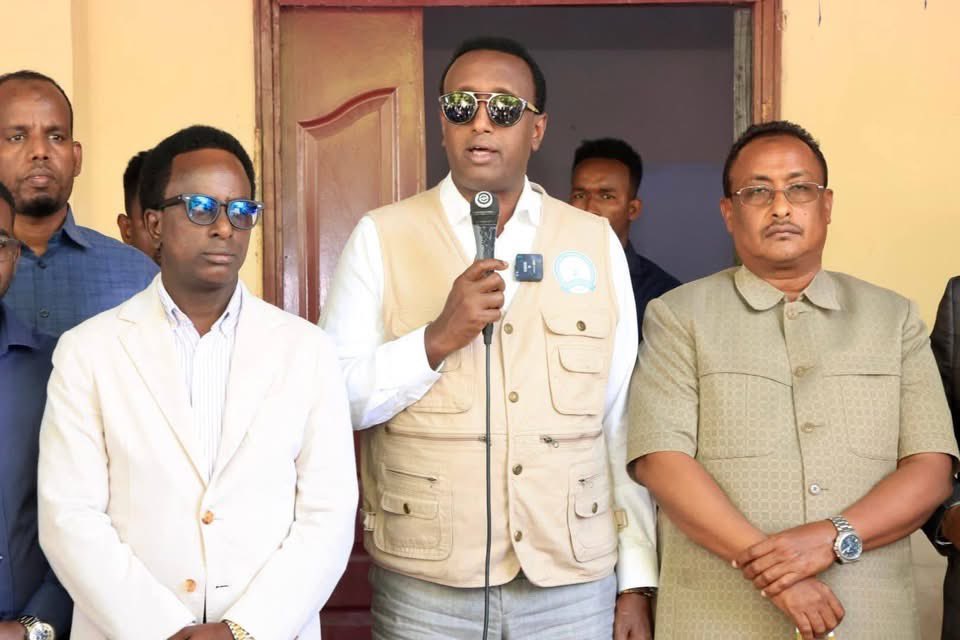
Somali NIEBC
Somalia’s National Independent Electoral and Boundaries Commission (NIEBC) has announced parliamentary elections for April 15, 2027, followed by a presidential election on May 15, 2027. While the announcement establishes an electoral timetable, its significance extends beyond the organization of elections. It brings into sharper focus unresolved disagreements over constitutional legitimacy, presidential tenure, federal–state relations and the authority to determine Somalia’s political future.
The central question is not simply whether Somalia can conduct elections in 2027, but whether an electoral process organized under a contested constitutional framework can produce institutions recognized as legitimate by the country’s principal political stakeholders. In a federal system still negotiating the distribution of powers, the consequences of proceeding without a broadly accepted settlement could extend well beyond electoral competition, affecting the cohesion of the federation, the credibility of national institutions and the wider state-building process.
An Electoral Calendar Without a Settled Constitutional Consensus
The commission’s October 15 announcement establishes a sequence of preparatory activities, beginning with voter and political party registration in November 2026 and culminating in parliamentary and presidential elections in April and May 2027. From an administrative perspective, the timetable offers greater predictability to political parties, candidates, electoral institutions and prospective voters.
Yet electoral scheduling and constitutional legitimacy are distinct questions. A commission may possess the administrative authority to organize elections while the constitutional framework governing those elections remains politically disputed. Somalia’s immediate challenge lies in this distinction: the announcement provides dates, but does not itself resolve disagreements over the constitutional amendments, the duration of the presidential mandate, the electoral model or the participation of federal member states.
According to the announced framework, the government interprets the revised constitutional provisions as establishing a five-year presidential term beginning with the president’s swearing-in. Opposition leaders dispute the application of those changes to the incumbent presidency, arguing that the mandate established under the previous constitutional framework expired in May 2026. The dispute therefore concerns more than the timing of the next election. It raises the question of whether constitutional amendments adopted during an existing political mandate can legitimately alter the duration of that mandate without a broader political settlement.
This distinction is particularly consequential in Somalia, where constitutional development has historically depended on negotiated political agreements among federal institutions, federal member states and other stakeholders. The announcement risks transforming an unresolved constitutional disagreement into an immediate institutional confrontation if the electoral calendar proceeds without an accepted basis for participation.
The Federalism Question: Can National Elections Proceed Without Federal Agreement?
Perhaps the most consequential dimension of the electoral announcement is its relationship to Somalia’s unfinished federal settlement. Puntland and Jubaland have rejected important elements of the constitutional revision process, arguing that changes affecting the distribution of political authority and the electoral system require meaningful agreement among the federal government and federal member states. Their objections are therefore not limited to the choice of electoral dates; they concern the constitutional foundations on which the next federal institutions will be established (Somalia Today).
The 2012 Provisional Constitution provides an important basis for understanding these objections. Article 50 identifies mutual cooperation and support between the federal government and federal member states as fundamental principles of federalism. Article 54 establishes negotiation and agreement as the basis for allocating powers and resources, except for specified exclusive federal responsibilities. Article 142 also provides protections for existing federal member states and requires their consultation on matters concerning the federal system and security arrangements. These provisions do not necessarily grant every state a veto over national elections, but they demonstrate that intergovernmental negotiation is integral to Somalia’s original federal constitutional design (2012 Provisional Federal Constitution).
The distinction matters because Somalia’s federalism is not simply an administrative arrangement through which Mogadishu delegates responsibilities to regional governments. It emerged from a negotiated state-building process intended to accommodate competing political authorities, territorial interests and historically rooted concerns about centralized power. Consequently, electoral reforms that significantly alter the relationship between federal institutions and member states cannot be assessed solely through the procedural authority of national electoral bodies. Their longer-term legitimacy also depends on whether they preserve the cooperative foundations of the federation.
Proceeding without Puntland and Jubaland could create a difficult institutional contradiction: Somalia might establish a new federal parliament and presidency through elections whose authority is rejected by governments representing significant parts of the federation. This would not automatically invalidate the institutions or make political fragmentation inevitable. It would, however, raise practical questions about their capacity to exercise authority, negotiate national policies, coordinate security arrangements and implement federal decisions across the country.
Puntland, Jubaland and the Risk of Competing Political Legitimacies
The convergence of Puntland and Jubaland around objections to the constitutional process represents a particularly important development. Although the two administrations have different political histories and relationships with Mogadishu, their shared concerns over constitutional amendments, electoral arrangements and federal autonomy create a basis for coordinated political resistance.
The danger is not necessarily an immediate declaration of separation or the dissolution of federal institutions. A more plausible risk is the gradual consolidation of competing centers of political legitimacy. Under such circumstances, Mogadishu could continue operating through federal institutions established under the revised constitutional framework, while dissenting federal member states and opposition actors maintain that the 2012 constitutional settlement remains the legitimate basis for national authority.
Such a divergence could weaken the practical functioning of federalism even without a formal constitutional rupture. Disagreements over electoral legitimacy could extend into disputes over revenue sharing, security coordination, public administration, international assistance and the recognition of federal decisions. What begins as a disagreement over the electoral calendar could consequently become a wider contest over which institutions possess the authority to govern and represent Somalia.
Former President Mohamed Abdullahi Farmaajo’s reported rejection of the timetable illustrates the broader opposition concern. His warning about competing electoral processes and possible conflict should be understood as a political warning rather than an inevitable forecast. Nevertheless, Somalia’s previous electoral crises demonstrate why disputes over political mandates can become particularly sensitive when competing actors possess organized constituencies, security relationships and territorial influence. The Somali Future Council has also continued to challenge the constitutional changes and the legitimacy of mandate extensions (Somalia Today).
One-Person, One-Vote Elections: Democratic Reform or a New Source of Exclusion?
The federal government’s ambition to move beyond Somalia’s indirect, clan-mediated electoral arrangements addresses a longstanding democratic deficit. A credible system of direct voting could broaden political participation, reduce the concentration of electoral influence among selected delegates and political intermediaries, and strengthen the relationship between citizens and their representatives. The government has presented constitutional reform and direct elections as important steps towards democratic development (Prime Minister’s Office).
However, the democratic value of direct elections cannot be measured by the voting method alone. Universal suffrage requires credible voter registration, accessible polling locations, transparent electoral boundaries, independent dispute resolution, political competition and effective safeguards against intimidation or exclusion. In Somalia, these requirements are further complicated by insecurity, displacement, uneven administrative capacity and the absence of a universally accepted constitutional framework.
An election that allows direct voting in some territories but cannot secure meaningful participation in others would raise difficult questions about representation. If substantial populations are excluded because of insecurity, administrative barriers or political non-cooperation, the resulting parliament could face challenges concerning the geographical and political breadth of its mandate.
The Upper House presents an especially consequential institutional question. Under Somalia’s federal design, it is intended to represent federal member states. An electoral process for this chamber that proceeds without the cooperation or recognition of major member states would therefore raise questions extending beyond ordinary electoral administration. It would concern the ability of a chamber designed to represent the federation to perform that function when the relationship between its constituent governments remains disputed.
The essential distinction is between electoral participation as a procedure and democratic legitimacy as an outcome. Direct voting can strengthen democracy, but only when the institutional framework provides a sufficiently inclusive, competitive and credible basis for translating votes into political authority.
Electoral Competition, Security Fragmentation and the Risk of Political Violence
Somalia’s electoral dispute is unfolding within a security environment in which political disagreements can have consequences beyond parliamentary debate. Federal security institutions, federal member state forces, clan-based armed groups and opposition-linked security networks operate within a political landscape where the boundaries between institutional authority and political allegiance are not always clearly established.
The June 2026 confrontation in Mogadishu involving federal forces and armed personnel associated with opposition figures demonstrated how disputes over political authority can escalate into localized violence. Although that confrontation did not develop into a broader conflict, it exposed the risks associated with the militarization of political disagreements and the importance of negotiated de-escalation (Reuters).
A contested electoral process could intensify these vulnerabilities if competing political actors attempt to enforce rival claims to constitutional authority. The most serious scenario would involve parallel political processes accompanied by mobilization of security forces or clan-based armed constituencies. Such an outcome is not predetermined, but the potential for escalation deserves attention because Somalia’s security architecture remains closely intertwined with its unsettled federal political arrangements.
There is also a direct counterterrorism implication. Al-Shabaab retains substantial territorial influence in parts of south-central Somalia and the capacity to conduct attacks. Political fragmentation could weaken coordination among security institutions, divert resources from stabilization operations and create opportunities for the insurgency to exploit divisions between federal and state authorities (European Union Agency for Asylum).
The broader concern is that an electoral process intended to strengthen democratic governance could inadvertently undermine security cooperation if its implementation deepens political mistrust. Somalia cannot sustainably separate electoral reform from the institutional relationships on which national security and territorial governance depend.
What the Electoral Dispute Means for Somalia’s State-Building Process
The deeper significance of the 2027 timetable lies in what it reveals about Somalia’s approach to state-building. Since the establishment of the federal government in 2012, national reconstruction has involved the simultaneous development of constitutional institutions, federal arrangements, security structures, public administration and political representation. Yet institutional expansion has frequently advanced faster than the political agreements necessary to regulate relationships among these institutions.
The current electoral dispute illustrates this imbalance. Somalia has developed a national electoral commission, revised constitutional provisions and adopted legislation intended to facilitate direct elections. However, the existence of these formal institutions has not produced an equivalent level of agreement over the rules governing political competition, the distribution of authority or the legitimacy of constitutional change.
This reflects a fundamental distinction between institution-building and state-building. Institution-building concerns the creation of formal organizations, legal mandates and administrative procedures. State-building requires those institutions to operate within a political order whose authority is sufficiently accepted, whose rules can be enforced impartially and whose competing interests can be managed without recurring institutional confrontation.
From this perspective, the central weakness is not necessarily the absence of electoral institutions, but the continuing difficulty of establishing shared political rules that remain binding regardless of which individuals or political coalitions control the presidency. When constitutional arrangements become closely associated with incumbent political interests, their legitimacy becomes vulnerable to changes in political leadership. Each electoral cycle can then reopen questions that functioning constitutional systems are expected to settle.
The consequences extend beyond national elections. Prolonged constitutional disputes can weaken public confidence, complicate intergovernmental cooperation, discourage long-term administrative planning and divert political attention from public service delivery, economic governance and security reform. They can also reinforce dependence on negotiated interventions by international partners, rather than strengthening domestic institutions capable of resolving constitutional disputes through predictable legal and political procedures.
The Path Forward: Political Settlement Before Electoral Consolidation
The announcement does not necessarily foreclose a negotiated solution. Indeed, an established electoral timetable could provide a practical framework around which the federal government, federal member states, opposition parties and civil society negotiate outstanding issues. But this would require treating the timetable as part of a wider political settlement rather than as a substitute for one.
A credible approach would need to address the constitutional basis of the current mandate, the legal and administrative framework for elections, the participation of federal member states, the representation of populations in insecure and disputed territories, and independent mechanisms for resolving electoral complaints. It would also require agreement on how the Upper House can fulfill its federal representative function and how the integrity of voter registration and political competition can be independently assessed.
The involvement of independent constitutional and judicial institutions would be especially important, although Somalia’s incomplete constitutional adjudication arrangements complicate that task. Political negotiation should not replace constitutional legality, but neither can the legitimacy of a contested constitutional order be secured exclusively through administrative decisions. A durable settlement requires both a defensible legal foundation and sufficiently broad political acceptance.
The international community also faces a delicate responsibility. Support for electoral administration, democratic participation and institutional development remains important, but external partners should avoid treating the completion of an electoral timetable as equivalent to the consolidation of legitimate governance. Their most constructive contribution would be to support Somali-led dialogue, impartial electoral safeguards and peaceful dispute resolution without determining the political outcome.
Conclusion: Elections May Produce a Government Without Settling the State
Somalia’s 2027 electoral timetable represents an important administrative development, but its political significance will ultimately depend on whether it becomes a vehicle for national agreement or a further source of constitutional division. The dates of April 15 and May 15 provide a schedule for institutional transition; they do not, by themselves, establish the legitimacy of the constitutional arrangements under which that transition is expected to occur.
The deeper challenge is that Somalia’s unfinished federal settlement continues to shape the legitimacy of national political institutions. Without a shared understanding of constitutional authority, electoral competition risks becoming another arena in which the federal government, member states and opposition actors contest the foundational rules of the state. Under such conditions, even technically successful elections may produce institutions whose authority remains politically disputed.
The potential consequences are substantial. A prolonged electoral confrontation could weaken federal cohesion, encourage competing claims to legitimacy, complicate security coordination and divert attention from urgent national priorities. Conversely, a negotiated electoral settlement could establish a more durable precedent for constitutional cooperation, demonstrating that political competition can be regulated through accepted institutions rather than recurring struggles over the rules themselves.
Ultimately, Somalia’s state-building challenge is not simply to hold elections, but to establish a constitutional order in which elections can change governments without threatening the foundations of the state. The decisive test of the 2027 process will therefore be whether it strengthens the legitimacy of Somalia’s federal institutions or reproduces the political disagreements that have repeatedly constrained Somalia’s state-building development.