The Somali Monitor
Somali Disaster Management Agency: Funding, Aid Delivery and Parliamentary Oversight
As Somalia confronts the threat of renewed El Niño-related flooding, widespread displacement and worsening humanitarian conditions, the management of emergency assistance demands closer attention. Against a complex political economy shaped by donor dependence, federal–state relations and competing institutional interests, the Somali Disaster Management Agency’s budget performance, aid distribution and parliamentary scrutiny raise important questions about how humanitarian resources are managed and translated into effective protection for disaster-affected communities.
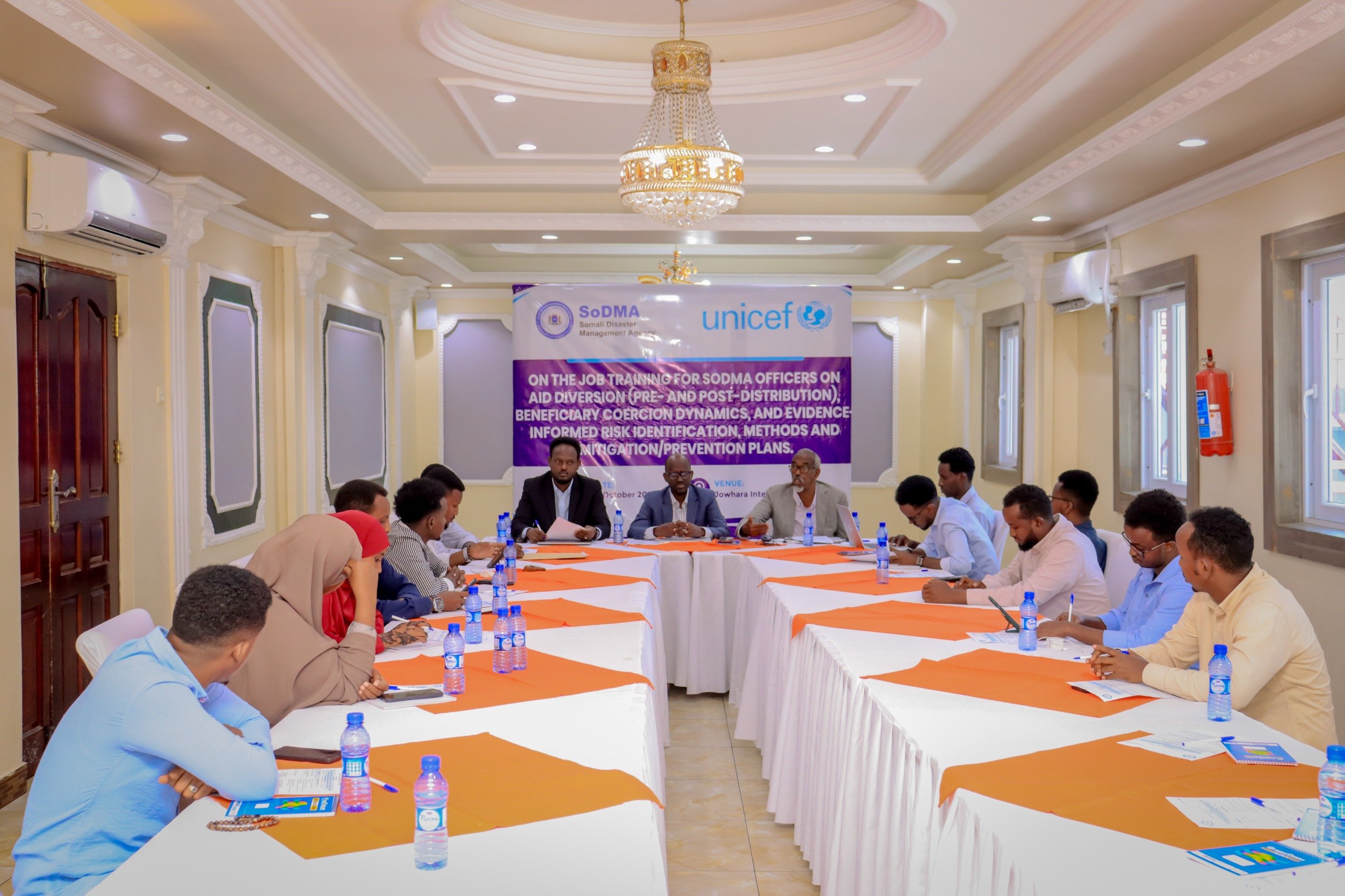
SoDMA X account — Staff aid-diversion training, October 2026
MOGADISHU, Somalia — As Somalia prepares for potential El Niño-related flooding during the October–December 2026 Deyr season, with up to 3.5 million people potentially exposed and approximately one million at risk of displacement, the Somali Disaster Management Agency (SoDMA) faces growing responsibilities for disaster preparedness, emergency response and the coordination of international humanitarian assistance.. Yet a question remains largely unanswered in the public record: how thoroughly are its finances, procurement decisions and aid distributions examined, and who is responsible when assistance fails to reach those in need? Commissioner Mahmoud Moallim Abdulle has briefed the Somali Parliament on humanitarian emergencies in the past, but the available reporting offers far less insight into legislative examination of the agency’s spending and management of donated supplies. The issue is not whether SoDMA undertakes relief operations, but whether its use of public and external resources can be properly accounted for.
The concern reflects broader weaknesses in Somalia’s humanitarian system. The Norwegian Refugee Council’s research on gatekeeping, the U4 Anti-Corruption Resource Centre’s study of aid diversion and the 2025 UN Inter-Agency Humanitarian Evaluation describe how political interests, local intermediaries and institutional weaknesses can influence access to humanitarian assistance. These studies do not implicate any institution including SoDMA in specific wrongdoing, but they establish the wider risks against which such institution’s financial controls and distribution practices should be assessed.
The Somali Parliament has questioned the SODMA agency, about emergencies and related responses. Radio Dalsan reported that Abdulle appeared before lawmakers in December 2023 to explain El Niño flooding and relief operations. On September 20, 2026, he joined the Interior Minister Mr. Ahmed in briefing a parliamentary committee on drought conditions and preparedness. Neither published account establishes whether legislators examined how aid is meaningfully distributed, contracts awarded, expenditure recorded, bilateral donations or the results of aid-diversion and corruption, if any, investigations. Explaining a humanitarian emergency in the offing like the aid agencies is one responsibility; accounting for the money which includes taxpayers’ and supplies mobilized in response is another.
More striking, the financial figures allocated to SODMA warrant a closer examination too. Somalia’s 2025 Appropriation Act initially allocated US$17.31 million to SoDMA. The Ministry of Finance’s year-end performance report subsequently recorded a revised budget of US$12.31 million, with actual expenditure of US$6.67 million—an execution rate of 54.2%. The US$5.64 million difference between the revised allocation and spending does not represent proven missing funds. However, it calls for an explanation of the reductions, financing delays or implementation problems involved, including which planned activities were not completed. The original allocation included US$8.93 million for goods and services and US$5 million for fixed assets, covering proposed investments such as insurance, training, consultancy, buildings and equipment. What matters is whether those provisions resulted in completed purchases, functioning systems and improved emergency response to affected populations.
The same 2025 financial report shows that the Office of the Prime Minister spent 98.8% of its revised allocation, compared with SoDMA’s 54.2%. Their mandates and funding arrangements differ, so the figures cannot establish which institution performed better. They nevertheless invite questions about the administrative constraints affecting SoDMA and how the federal government supervises the agency’s financial performance.
The 2026 Budget Policy Framework adds another dimension. It proposed US$7.22 million for SoDMA, including US$4.04 million, or 55.9%, for a donor-funded projects and US$2.87 million, or 39.8%, for governance and administration. Just US$311,340, equivalent to 4.3%, was explicitly assigned to government humanitarian action and disaster management. Excluding the donor project, roughly 90% of the remaining proposed allocation fell under administration. These are planning figures, not independently confirmed final appropriations, and administrative spending can support essential operations. Even so, the structure raises a difficult question: is the federal government investing enough in its own disaster-response capacity, or is it financing the institution’s administration while depending heavily on donors to support its programmes? That question carries greater weight after the agency’s low spending rate in 2025.
In addition, the management of bilateral donations presents a related challenge. In January 2025, the United Arab Emirates announced a 700-tonne food contribution, with consignments intended for different parts of Somalia. The agency has also reported humanitarian cooperation with China. Such assistance may be delivered through arrangements involving donors, federal institutions and local partners. This makes it essential to establish which organization received each consignment, who controlled its distribution and whether the supplies reached the communities identified. Three disputes show why those records matter. In December 2023, Horn Observer reported allegations concerning relief supplies intended for Mahaday and Jowhar, including contested truck movements. In January 2025, Puntland’s humanitarian minister disputed SoDMA’s claim concerning 200 tonnes of UAE-donated food reportedly sent to Bosaso, Puntland. Further reporting from Garowe described her objections to relief being channelled through a politician rather than Puntland’s authorities. In May 2025, Hirshabelle suspended cooperation with SoDMA following controversy over medical supplies delivered to Moqokori location. SoDMA defended the operation and published a list of medicines. None of these competing accounts independently proves aid diversion, theft or corruption. They do, however, expose recurring disagreements over who controls humanitarian deliveries and how contested claims can be resolved through reliable documentation. (Somali Observatory for Humanitarian Affairs)
Against this backdrop, SoDMA has acknowledged the importance of preventing diversion. Its 2022–2024 Achievement Report describes institutional safeguards, and in September 2025 it announced a UNICEF-supported workshop on investigation procedures. Yet the UN’s humanitarian evaluation found that diversion risks across the wider response had initially been underestimated and reforms were slow. The report does not attribute those failures specifically to SoDMA. The unanswered question is whether the agency’s own measures have led to documented investigations, recoveries, disciplinary decisions or other corrective action.
Concerns have also reached the legislature. In December 2025, MP Gobsan Muhumed Omar reportedly demanded greater scrutiny of SoDMA’s donations and financial management. Publicly accessible records reviewed do not establish whether that intervention led to a dedicated financial hearing, an audit referral or published recommendations. This does not mean no proceedings occurred, but it leaves their outcome unclear. Somalia’s Ministry of Finance, Auditor General and parliamentary committees already have responsibilities that could help establish the relationship between approved spending, external contributions and actual delivery.
The available evidence does not establish a specific financial or legal breach by SoDMA. What emerges instead is a set of unresolved questions involving budget execution, dependence on donor-supported programmes, disputed shipments and the effectiveness of internal controls. Each requires examination on its own merits, but together they point to a larger institutional weakness: public reporting provides considerably more information about humanitarian activities and announced contributions than about the results of detailed financial scrutiny.
For Somalia’s disaster-affected communities, the ultimate measure of accountability is not how much aid is announced, how many budgets are approved or how often officials appear before Parliament. It is whether the resources entrusted to public institutions can be traced to their intended purposes, the assistance reaches those who need it, and failures are investigated and addressed.