The Somali Monitor
Quartet to Facilitate Somalia's Electoral Talks, with Puntland and Jubaland
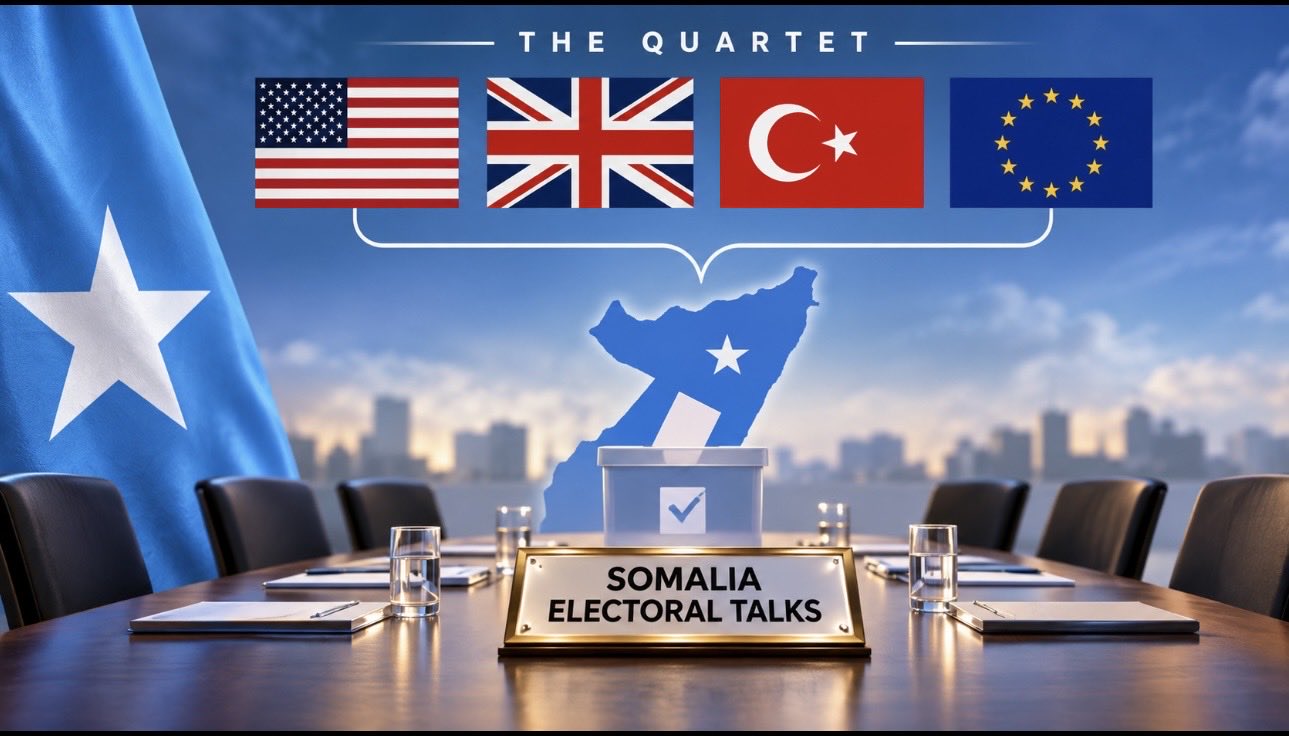
As reported, the Quartet—the UK, US, Türkiye and EU—has agreed to facilitate Somalia’s November 14–18 electoral talks, with Puntland and Jubaland expected to participate, amid deepening constitutional disputes and political tensions. The talks aim to secure a consensual electoral framework and break the political deadlock.
MOGADISHU — November 9, 2026
The reported agreement by the United States, United Kingdom, Türkiye and European Union to facilitate Somalia’s November 14–18 electoral negotiations, with the anticipated participation of Puntland and Jubaland, marks a potentially significant diplomatic development amid the country’s deepening political and constitutional confrontation. The initiative comes as President Hassan Sheikh Mohamud faces mounting opposition to his electoral agenda, competing interpretations of constitutional authority and increasing pressure to reach a negotiated settlement before political disagreements further undermine the country's fragile institutional and security arrangements.
Under the reported arrangement, the Quartet would facilitate discussions aimed at agreeing on an electoral model, establishing a joint election-management mechanism and defining principles for the political transition. The negotiations are expected to involve senior political leaders and technical teams responsible for translating any agreement into practical electoral arrangements. Reports also indicate that troop-contributing countries have been approached to provide security guarantees for Puntland President Said Abdullahi Deni and Jubaland President Ahmed Mohamed Islam, commonly known as Ahmed Madobe. These arrangements, including the Quartet's precise facilitation role, have not yet been formally confirmed in a joint diplomatic statement.
The anticipated involvement of Puntland and Jubaland is particularly consequential. Both federal member states have challenged the Federal Government's constitutional amendments and electoral framework, while maintaining longstanding disagreements with Mogadishu over federal powers, political representation and security responsibilities. Their participation would broaden negotiations beyond the opposition groups based in Mogadishu and bring two influential regional administrations directly into discussions over the country's electoral transition. However, their attendance would not necessarily indicate acceptance of the government's existing electoral proposals, particularly given their previous objections to decisions taken without broad federal consensus.
The political environment surrounding the negotiations has changed substantially since President Hassan Sheikh invited opposition leaders to talks from November 14 to 18. The Supreme Court's November 5 ruling, which reportedly rejected the application of presidential and parliamentary mandate extensions to current officeholders, directed stakeholders to agree on an electoral framework within 30 days and conduct elections within 90 days. The court also limited the Federal Government to caretaker responsibilities, although the Attorney General's Office has disputed the ruling's legal effect. This confrontation places the proposed negotiations at the centre of competing claims over constitutional authority, political legitimacy and the legal basis for the next elections.
Consequently, the Quartet would be facilitating more than a discussion over direct or indirect voting. The central disagreement now concerns which institutions possess the authority to determine Somalia's electoral timetable, who should administer the process and whether a negotiated agreement can reconcile the court's directions with the Federal Government's previously announced parliamentary and presidential elections in April and May 2027. Any political settlement that fails to address these competing claims risks creating further disputes over its legality and implementation.
The proposed international intervention has important historical parallels. The same diplomatic partners were involved in efforts to resolve Somalia's 2020–2022 electoral confrontation under former President Mohamed Abdullahi Farmaajo. Following the controversial two-year mandate extension approved by Parliament in April 2021, international pressure and negotiations among Somali political leaders contributed to the May 27 agreement that eventually enabled the 2022 elections. Nevertheless, that settlement addressed the immediate political impasse without resolving deeper disagreements over constitutional interpretation, federal–state relations and the independence of electoral institutions.
The recurrence of similar disputes under President Hassan Sheikh illustrates the limitations of political agreements negotiated primarily to overcome immediate crises. International partners have repeatedly supported Somalia's electoral transitions, yet successive administrations have continued to confront disputes over mandates, electoral administration and the distribution of political authority. The challenge for the Quartet is therefore not simply to facilitate another agreement, but to support arrangements capable of reducing the institutional uncertainty that has repeatedly brought Somalia to the brink of political confrontation.
Türkiye's reported participation adds another important dimension. Ankara maintains extensive military, diplomatic and institutional relationships with the Federal Government, giving it considerable influence in Mogadishu. However, opposition representatives have previously expressed concerns about Turkish-led mediation and called for broader international participation. The Quartet arrangement could respond to those concerns by distributing facilitation responsibilities among several partners. Its credibility, however, would depend on whether the negotiating parties regard the process as sufficiently impartial, particularly when international actors also maintain substantial security and financial relationships with the incumbent administration.
The reported request for security guarantees for Deni and Ahmed Madobe further illustrates the depth of mistrust between Villa Somalia and the two regional leaders. If confirmed, such arrangements would suggest that their participation requires assurances beyond ordinary federal security arrangements. Yet their presence alone would not guarantee a unified opposition position. Former Presidents Farmaajo and Sheikh Sharif Ahmed, alongside other opposition figures and political organizations, represent different constituencies and interests. Although they share objections to aspects of the administration's electoral agenda, their preferred political arrangements and negotiating priorities are not necessarily identical.
The talks also coincide with growing uncertainty surrounding Somalia's security transition. Uganda's withdrawal of troops deployed under a separate bilateral arrangement, alongside continuing concerns over the financing and operational sustainability of the African Union Support and Stabilization Mission in Somalia (AUSSOM), has increased attention to potential security gaps. With Al-Shabaab continuing to threaten government-controlled areas, prolonged political confrontation could further complicate coordination between federal and regional security institutions. For international partners, securing an electoral settlement is therefore closely connected to maintaining political stability and continuity in counterterrorism cooperation.
However, Somalia's previous electoral crises demonstrate the risks of prioritizing short-term stability over durable institutional arrangements. Agreements reached under diplomatic pressure have sometimes resolved immediate confrontations while leaving unresolved the constitutional and administrative disputes that subsequently re-emerge. A credible settlement would therefore require more than agreement on election dates. It would need clear provisions governing the electoral model, the independence and composition of election-management bodies, federal member state participation, implementation responsibilities and mechanisms for resolving disagreements.
The closure of the United Nations political mission has also altered Somalia's diplomatic landscape, reducing the established international mediation architecture at a time when political tensions are intensifying. The Quartet's reported involvement could partly fill this gap, although the legitimacy of the process would ultimately depend on Somali political ownership rather than external diplomatic influence.
Ultimately, the proposed November negotiations present an opportunity to bring the Federal Government, Puntland, Jubaland and opposition leaders into a more structured political process at a moment when constitutional disputes and security uncertainties have converged. The Quartet's involvement could provide diplomatic assurances and help bridge disagreements that previous consultations have failed to resolve.
The decisive question, however, is whether the talks can produce a politically acceptable, constitutionally defensible and enforceable electoral settlement. Somalia's experience since 2021 demonstrates that international mediation can help break immediate political deadlocks, but without institutional safeguards and genuine federal consensus, another negotiated compromise could simply postpone the country's next electoral confrontation.