The Somali Monitor
“Please Resign, Mr. President” Deni Urges Hassan
Puntland Regional President Said Abdullahi Deni's call for President Hassan Sheikh to resign comes amid disputed constitutional amendments and federal elections, political turmoil in Hirshabelle, armed confrontation in South West State, persistent Al-Shabaab threats, the closure of UNTMIS on 31 October, Uganda's military withdrawal and Israel's recognition of Somaliland. Together, these developments raise serious questions about Somalia's political cohesion, national security and the sustainability of decades of state-building investment.
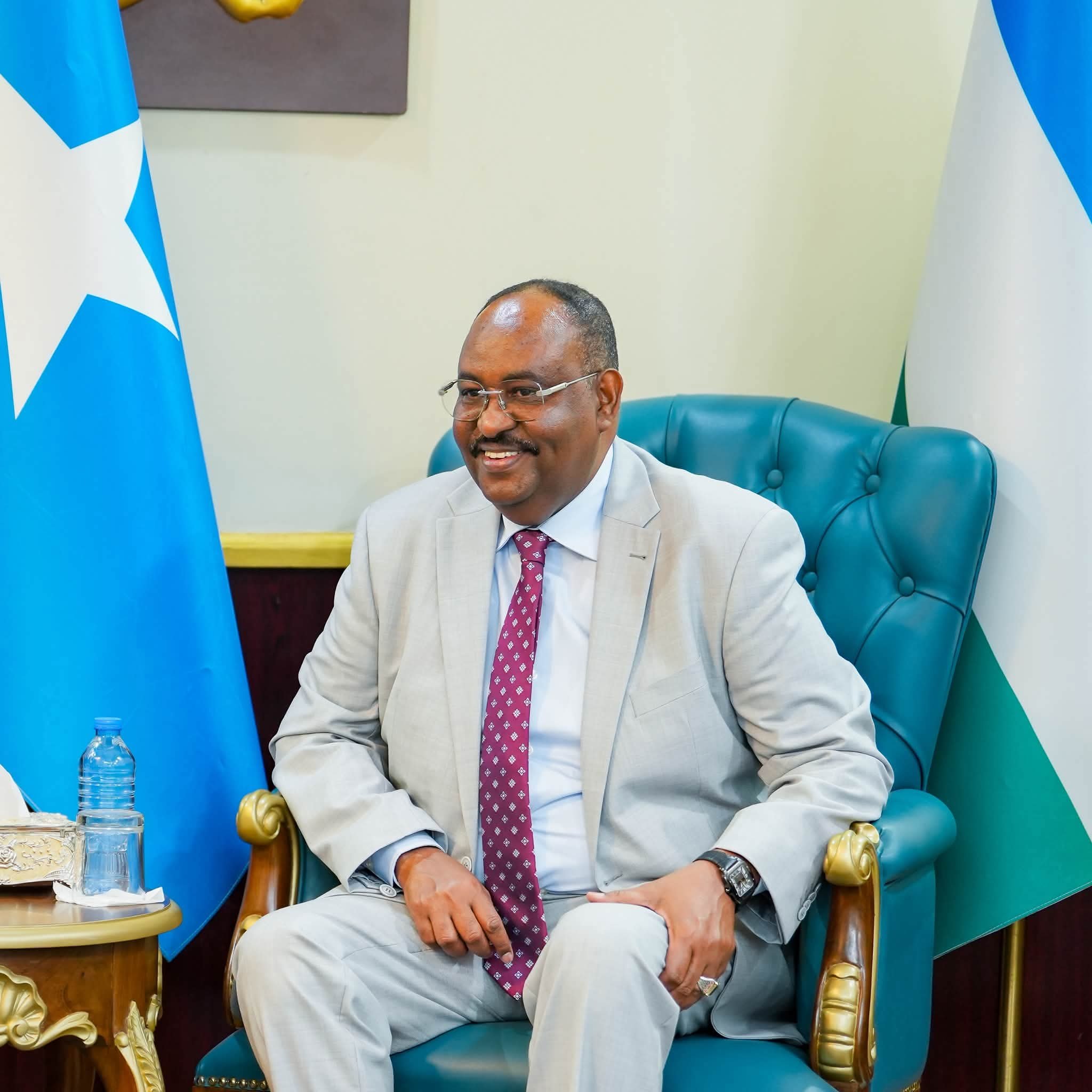
Photo courtesy of Puntland State House
MOGADISHU, Somalia — Puntland President Said Abdullahi Deni's call for President Hassan Sheikh Mohamud to resign on 31 October 2026 reflects a wider dispute over the direction of Somalia's state-building project. After decades of national reconstruction and international investment, the country faces a contradiction: greater political and security responsibilities are being transferred to Somali institutions while disagreements over constitutional authority, electoral legitimacy and federal power-sharing remain unresolved. Deni's warning coincides with the closure of the United Nations political mission, Uganda's changing military deployment, armed confrontation in South West State and persistent Al-Shabaab threats in Hirshabelle. Israel's recognition of Somaliland has added another challenge to Somalia's territorial integrity. The central question extends beyond one presidency to whether political fragmentation is weakening the institutions expected to sustain national stability. (Horseed Media, 31 October 2026).
Deni's intervention carries particular significance given Puntland's role in Somalia's federal reconstruction since its establishment in 1998. By emphasizing its political, financial and institutional contributions, he framed Puntland's opposition to the current administration as a disagreement over national governance rather than a rejection of Somali unity. His position reflects disputes over the 2026 constitutional amendments, electoral arrangements and the distribution of federal authority. Successive negotiations, including talks that ended without agreement in July 2026, have failed to produce a mutually accepted electoral framework. Nevertheless, President Hassan Sheikh's administration has continued preparations, with parliamentary elections scheduled for 15 April 2027 and a presidential election for 15 May 2027, despite objections from Puntland, Jubaland and opposition groups. Further consultations have been proposed for 14–18 November 2026. The disagreement concerns whether electoral reforms can provide a legitimate national transition without sufficient agreement among the principal federal stakeholders. (Hiiraan Online, 15 October 2026; Hiiraan Online, 26 October 2026).
The security consequences of political divisions are particularly evident in South West State, where the dispute involving former President Abdiaziz Hassan Mohamed Laftagareen has developed into armed confrontation. Forces aligned with Laftagareen reportedly captured Buurhakaba on 15 October, while further fighting occurred near Baidoa on 26 October. Competition for strategic locations along the Mogadishu–Baidoa corridor threatens civilian movement, commercial supplies and humanitarian access. Rival political actors have exchanged accusations concerning security and legitimacy, including contested allegations of links to Al-Shabaab. According to ACLED, these confrontations reflect overlapping political and territorial disputes. For Baidoa's displaced population, the consequences include further insecurity and disruption of essential services. A UNHCR flash alert issued on 6 October documented more than 5,600 people displaced by earlier clashes, demonstrating how political competition can compound an existing humanitarian emergency.
In Hirshabelle, the principal threat remains Al-Shabaab's ability to recover territory and challenge government control. The European Union Agency for Asylum's June 2026 assessment documented the group's advances in Hiraan and Middle Shabelle, including insecurity around Mahas, Moqokori and Adan Yabaal. Although Somali forces have continued counteroffensives, the reversals illustrate the difficulty of sustaining military gains without reliable local alliances, functioning administration and coordinated security arrangements. The threat extends into southern Somalia, where an Associated Press report of 28 October 2026 documented a deadly Al-Shabaab attack against Somali soldiers in Bay region. These developments underline the risks of political confrontations diverting attention and resources from counterinsurgency operations.
The security pressures coincide with the closure of the United Nations Transitional Assistance Mission in Somalia (UNTMIS) on 31 October 2026, following a two-year transition requested by the Federal Government. Under Security Council Resolution 2753 (2024), the former United Nations Assistance Mission in Somalia became UNTMIS in November 2024, progressively transferring responsibilities to Somali institutions and UN partners. Resolution 2809 (2025) confirmed its closure, ending 13 years of successive UN special political missions while the wider UN humanitarian and development presence continues. The transition advances national ownership but removes an established channel for political facilitation at a time when constitutional and electoral disagreements remain unresolved. Following unsuccessful negotiations in July, opposition groups sought further international mediation, illustrating the continuing absence of a broadly accepted domestic mechanism for resolving federal political disputes. (United Nations, 26 October 2026; Associated Press).
Uganda's recent statements and military decisions introduce another concern. During President Hassan Sheikh's visit to Entebbe on 26 October, President Yoweri Museveni emphasized that defeating Al-Shabaab required political unity and organization beyond military operations. Three days later, Uganda's Chief of Defence Forces, General Muhoozi Kainerugaba, announced that Ugandan troops had begun withdrawing after nearly two decades of engagement. The immediate withdrawal concerns additional bilateral forces rather than Uganda's entire contingent under the African Union Support and Stabilisation Mission in Somalia (AUSSOM). Nevertheless, the handover raises questions about the Somali military's ability to secure recovered territory amid funding pressures, insurgent activity and political disputes affecting national security coordination. (Ugandan Presidency; The EastAfrican, 30 October 2026).
Beyond these internal challenges, Israel's formal recognition of Somaliland on 26 December 2025 introduced a significant diplomatic complication for Somalia's territorial integrity. Somaliland welcomed the decision as progress towards international recognition, while the Federal Government rejected it as a violation of sovereignty. The African Union and several international partners reaffirmed their support for Somalia's unity. Although Somaliland's pursuit of independence differs fundamentally from Puntland and Jubaland's disputes within the federal system, these developments expose the unresolved nature of Somalia's territorial and constitutional settlement. Israel's decision has not established broader international acceptance of Somaliland's independence, but it adds pressure to Mogadishu's diplomatic efforts while domestic political consensus remains fragile. (Reuters, 26 December 2025).
The convergence of these developments exposes a contradiction in Somalia's transition towards national ownership. While international partners transfer political and security responsibilities, federal and regional leaders remain divided over the constitutional arrangements necessary to exercise those responsibilities collectively. Somalia has reconstructed federal institutions, established member states, improved public financial management, secured international debt relief and rebuilt elements of its military through substantial national, diaspora and international investment. Yet recurring confrontations over political authority, regional leadership and institutional control raise questions about the sustainability of these achievements. A functioning state requires more than established institutions, trained forces and financial support; it also depends on constitutional legitimacy, political neutrality and cooperation among competing authorities.
For communities facing displacement, food insecurity and insecurity, the consequences of fragmentation extend beyond political disputes. Armed confrontation can restrict humanitarian access, disrupt essential services and weaken civilian protection, while competition over public institutions risks diverting resources from national recovery. The return on decades of state-building investment must therefore be measured not simply by the existence of institutions, but by their capacity to serve citizens and function during political disagreement.
Ultimately, Deni's demand for President Hassan Sheikh to resign remains a political position rather than an agreed constitutional solution. Its broader significance lies in the warning that Somalia's reconstruction cannot be sustained through formal institutions alone. The country's achievements remain substantial, and renewed collapse is not inevitable. However, the convergence of disputed elections, armed confrontation, insurgent threats, changing international security arrangements and external diplomatic challenges places growing pressure on its federal settlement. Somalia's future will depend less on the departure of international missions than on whether its political leadership can protect the institutions and agreements built through decades of sacrifice from recurring struggles over power.