
The Somali Monitor
New Chief Justice Sworn-in Despite Constitutional Confrontation: What Comes Next?
The swearing-in of Ibrahim Idle Suleiman as Somalia’s new Supreme Court Chief Justice, following the disputed dismissal of Baashe Yusuf Ahmed, has deepened the constitutional confrontation between the presidency and judiciary. Amid contested presidential mandates, allegations of political interference and approaching federal elections, the appointment raises critical questions about judicial independence, executive authority and the future of Somalia’s constitutional governance.
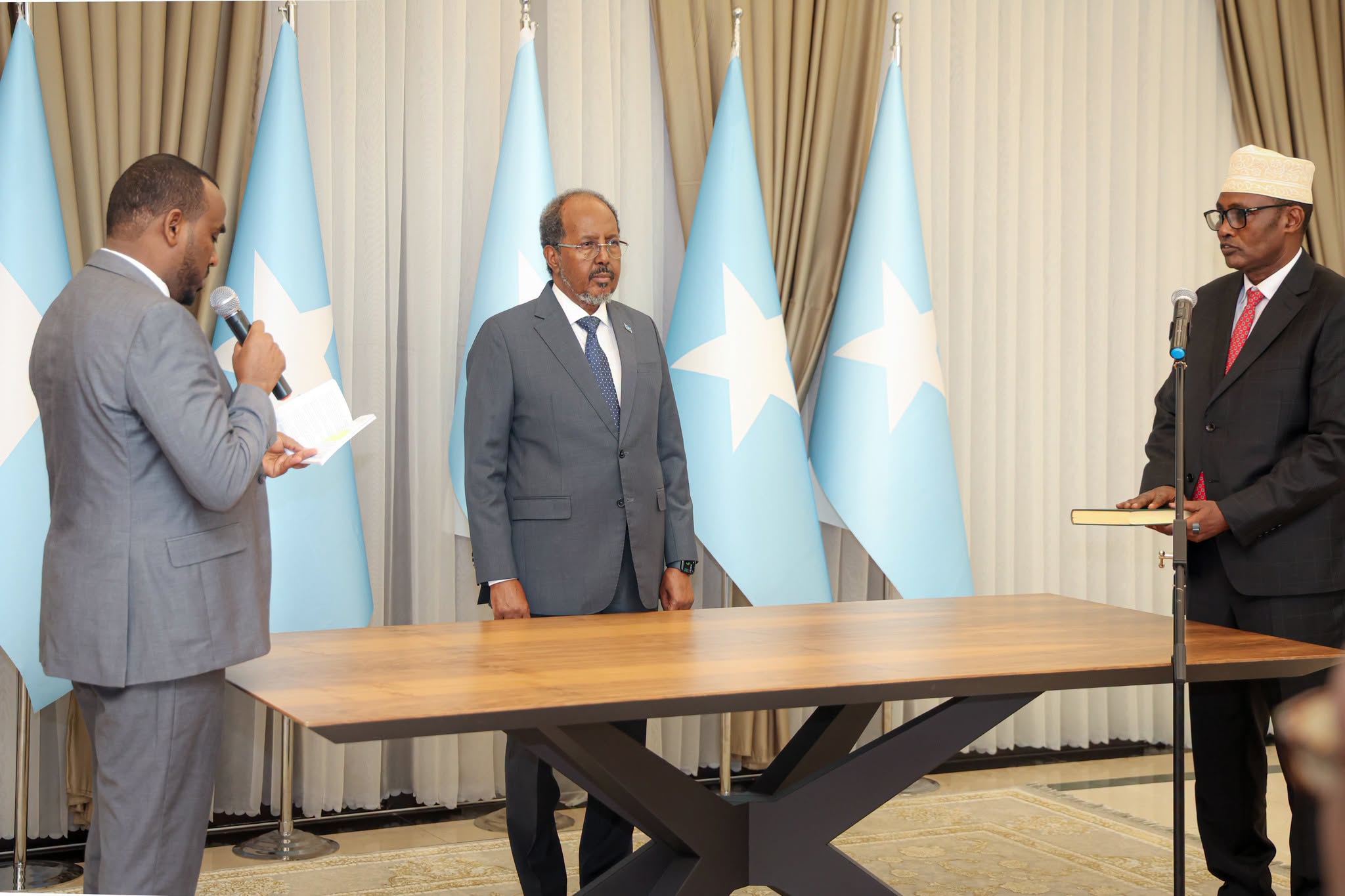
Photo: Courtesy of Villa Somalia’s official Facebook page
MOGADISHU, 7 November 2026 — President Hassan Sheikh Mohamud’s decision to proceed with the swearing-in of Ibrahim Idle Suleiman as Somalia’s new Supreme Court Chief Justice marks a significant development in the confrontation between the presidency and the judiciary. The ceremony, held at Villa Somalia on Saturday, followed the disputed dismissal of former Chief Justice Baashe Yusuf Ahmed and a Supreme Court ruling challenging the constitutional basis of the president’s continued tenure. What would ordinarily be a judicial leadership transition has consequently become part of a wider dispute over executive authority, judicial independence and Somalia’s electoral future.
The oath was administered by Member of Parliament Mohamed Abdirahman Adan, a member of the parliamentary committee responsible for justice affairs. President Hassan Sheikh witnessed the ceremony alongside Prime Minister Hamza Abdi Barre, the Speaker of the House of the People, the First Deputy Speaker of the Upper House and the Minister of Justice. According to Goobjoog, the president urged the incoming Chief Justice to uphold judicial independence, transparency and accountability. The presence of senior executive and parliamentary officials publicly demonstrated the federal leadership’s recognition of Ibrahim Idle Suleiman. However, participation in the ceremony does not necessarily constitute the formal parliamentary approval required under the disputed constitutional appointment procedures.
The subsequent institutional handover further consolidated the new Chief Justice’s administrative authority. The Somali National News Agency reported that Ibrahim Idle Suleiman formally assumed office through a separate ceremony involving Abdalle Haji Mohamed and senior judicial officials. Together, the oath-taking and handover demonstrate that the presidency has moved beyond announcing the appointment to establishing new leadership at the Supreme Court. Yet the distinction between exercising institutional authority and establishing the legality of that authority remains central to the controversy.
The confrontation originated in a constitutional petition submitted by former President Sheikh Sharif Sheikh Ahmed on 11 October 2026, challenging amendments to Somalia’s constitutional framework and their implications for incumbent federal institutions. The petition questioned whether revised five-year presidential and parliamentary mandates could lawfully apply to officials elected under the previous four-year system. The case brought before the Supreme Court an issue that had already divided the presidency, opposition leaders and federal member states over the legitimacy of the current electoral timetable.
On 4 November, President Hassan Sheikh dismissed Baashe Yusuf Ahmed and restored Ibrahim Idle Suleiman, who previously served as Chief Justice before being replaced in 2018. The presidency cited complaints concerning judicial administration and the functioning of the courts. However, the timing attracted scrutiny because the Supreme Court was considering proceedings with direct implications for the president’s mandate. The following day, the court rejected Baashe’s dismissal as unconstitutional, citing safeguards governing judicial independence and the removal of senior judicial officials. According to Hiiraan Online, the court referred to constitutional provisions requiring the involvement of the Judicial Service Commission and parliamentary approval.
The dispute intensified when a five-judge panel ruled that constitutional amendments extending presidential and parliamentary terms did not automatically prolong the mandates of incumbent officeholders. The judges concluded that President Hassan Sheikh’s original mandate had expired on 15 May 2026 and parliament’s on 14 April, directing political stakeholders to agree on an electoral framework within 30 days and conduct elections within 90 days. The ruling distinguished between adopting longer constitutional terms and applying those changes to existing officials. The Attorney General’s Office rejected the judgment, challenging the panel’s composition, jurisdiction and procedures. Somalia therefore faces two connected disputes: whether the president retains constitutional authority under the amended framework and whether he lawfully exercised that authority in replacing the Chief Justice.
Ibrahim Idle Suleiman’s political and institutional background adds another dimension. He was appointed Chief Justice during Hassan Sheikh’s earlier presidency in 2016 before being replaced under President Mohamed Abdullahi Farmaajo in 2018, a decision he himself challenged. More recently, reporting has associated him with a legal advisory role linked to Hassan Sheikh’s Justice and Solidarity Party, including during Galmudug’s electoral activities. These associations do not establish that he will act according to the presidency’s preferences, but they are relevant to public perceptions of judicial independence when the appointing president is simultaneously involved in constitutional litigation.
The Galmudug connection is particularly significant. In August 2026, the Supreme Court under Baashe Yusuf Ahmed annulled the results of Galmudug’s July parliamentary and local council elections over constitutional and electoral irregularities. Fresh elections followed, preceding the election of Liibaan Ahmed Hassan as Galmudug president in October. Baashe has since alleged that politically sensitive proceedings involving Galmudug and the federal constitutional petition contributed to his dismissal. Although these allegations remain unproven and the presidency has offered a different explanation, they highlight the potential consequences for judicial independence when court decisions affect influential political interests.
The wider concern is whether Somalia’s judiciary can exercise authority independently when its decisions directly affect the executive. Judicial independence does not place senior judges beyond lawful accountability or removal, but it requires transparent procedures protected from political retaliation. Equally, judicial rulings must comply with constitutional jurisdiction and procedural safeguards. The current confrontation cannot be resolved simply through an executive appointment or competing assertions of judicial authority without an accepted legal process.
The absence of a fully operational Constitutional Court, as envisaged in Somalia’s constitutional architecture, further complicates the dispute. The Supreme Court has assumed a central role in constitutional disagreements, yet the executive has challenged the authority of the judges issuing rulings against it. This institutional gap makes it difficult to secure an accepted resolution and increases the likelihood that constitutional disputes will become entangled in political negotiations.
The implications extend directly to Somalia’s approaching elections. The federal electoral commission has scheduled parliamentary elections for 15 April 2027 and a presidential election for 15 May 2027, while the disputed Supreme Court ruling calls for an accelerated transition. Opposition leaders and the administrations of Puntland and Jubaland continue to demand a negotiated electoral framework. President Hassan Sheikh’s proposed consultations in Mogadishu from 14 to 18 November may provide an opportunity for dialogue, although disagreements over constitutional legitimacy and electoral administration remain unresolved.
The immediate questions now concern whether the new Chief Justice will recognise the constitutional rulings issued before his appointment, how pending proceedings involving the presidency will be handled and whether objections to Baashe’s dismissal can receive an independent legal determination. For Ibrahim Idle Suleiman, the challenge is not merely assuming office but maintaining the Supreme Court’s institutional credibility at a time when its independence is under scrutiny. For the presidency, proceeding with the appointment establishes administrative continuity but also raises the political stakes surrounding its commitment to constitutional safeguards.
Ultimately, the 7 November swearing-in has established the federal executive’s chosen leadership of the Supreme Court without resolving the constitutional objections surrounding Baashe Yusuf Ahmed’s removal or the rulings concerning federal mandates. The controversy reflects a broader challenge in Somalia’s state-building process: constitutional institutions cannot provide meaningful checks on political authority unless their independence and decisions are protected by enforceable procedures. Whether the present confrontation develops into a prolonged institutional crisis will depend on the willingness of Somalia’s political and judicial authorities to resolve competing legal claims through constitutional processes and an agreed electoral transition.