
The Somali Monitor
The National Leadership Academy in Kismayo: One of Prime Minister Hamza’s Legacies
The establishment of the National Leadership Academy in Kismayo connects Prime Minister Hamza Abdi Barre's governance agenda with Somalia's National Transformation Plan, offering a potentially lasting investment in public-sector leadership, stronger federal institutions and administrative reform.
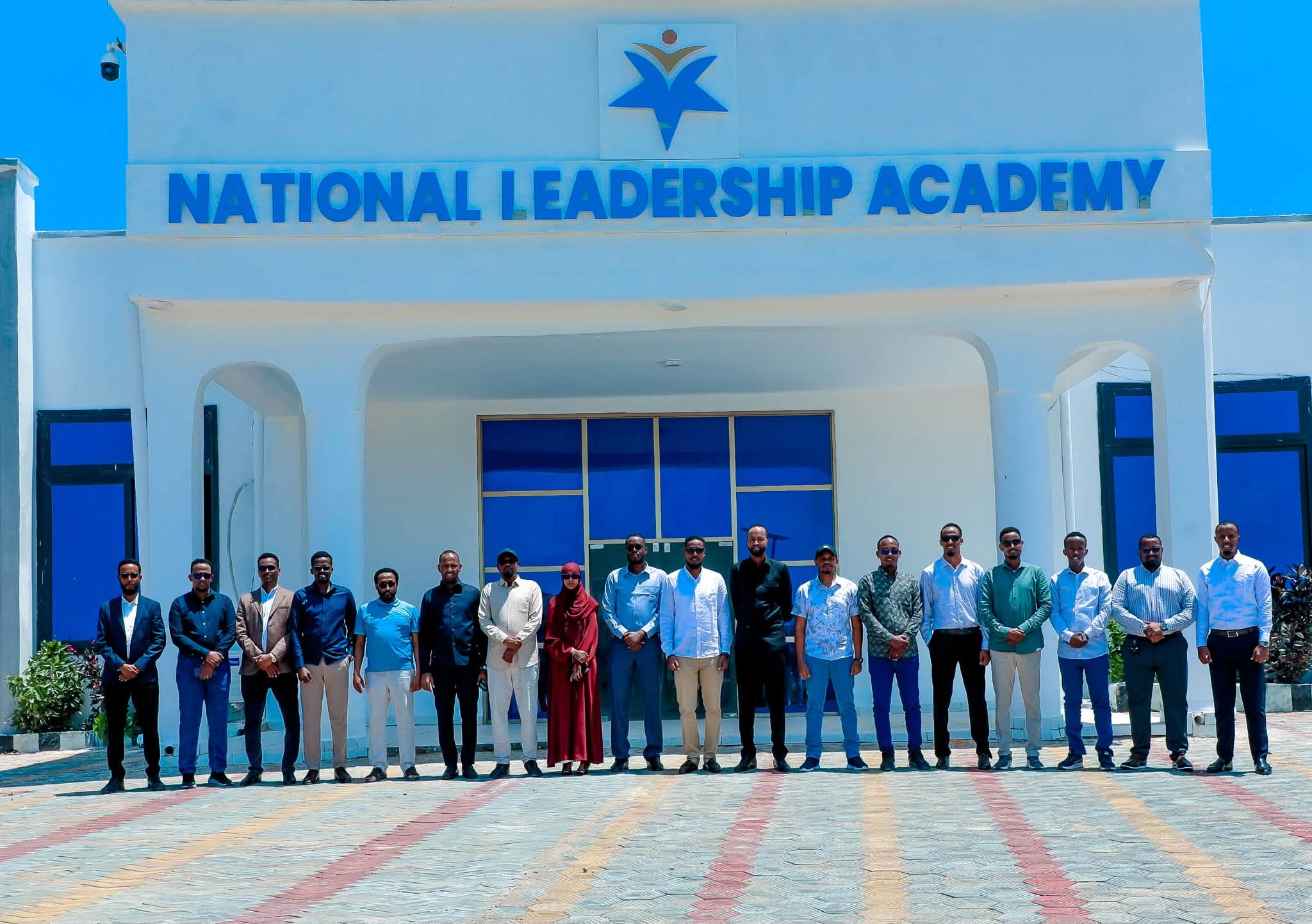
Photo courtesy of the National Leadership Academy’s official Facebook page
MOGADISHU, Somalia — The establishment of the National Leadership Academy (NLA) in Kismayo in 2025 represents an emerging approach to Somalia's institutional reconstruction, shifting attention from establishing government structures toward developing the professional leadership required to sustain them. Under Prime Minister Hamza Abdi Barre's administration, the academy offers an opportunity to strengthen public administration, develop future leaders and connect federal institutions with their counterparts in Federal Member States. Its significance extends beyond professional training to a broader question of whether investments in national institutions can produce lasting benefits beyond individual political administrations.
Somalia's state-building process has involved considerable investment in ministries, commissions, security institutions and federal administrative structures. Yet these investments have not consistently translated into effective public services, institutional continuity or reliable administrative performance. Political transitions frequently disrupt appointments and government priorities, while professional expertise remains unevenly distributed. According to the National Leadership Academy's institutional profile, its programmes target senior policymakers, civil-service managers, emerging leaders and civil society representatives. By establishing a permanent mechanism for professional development, NLA could help preserve institutional knowledge and strengthen the administrative capacity necessary for Somalia's federal system to function.
The decision to establish its headquarters in Kismayo, Jubaland's administrative capital, adds particular significance. National institutions and professional opportunities have historically been concentrated in Mogadishu, despite Somalia's commitment to a federal system intended to distribute responsibilities across different levels of government. Locating a national academy in Kismayo demonstrates how institutional investment can extend beyond the federal capital while serving the wider country. For Jubaland, it creates opportunities for professional employment, educational activities and local economic engagement. For Prime Minister Hamza, whose political background is closely associated with the region, the academy offers a potential institutional legacy that could remain relevant beyond his administration, provided it develops into an accessible and professionally independent national institution.
The academy's objectives align with Somalia's National Transformation Plan (NTP) 2025–2029, the government's medium-term development framework and the first phase of Centennial Vision 2060. The plan prioritizes transformational governance, economic development, social and human capital development, and environmental resilience. Achieving these objectives requires more than financial commitments and policy documents; it depends on public officials capable of managing resources, implementing reforms and delivering services. NLA could contribute to this agenda by developing competencies in leadership, public financial management, strategic planning and policy implementation, creating a practical connection between national development priorities and the institutions responsible for achieving them.
This relationship is supported by documented international financing. According to UNDP's signed Somalia Transformational Governance Programme document, approximately US$1.675 million was budgeted specifically for NLA's operationalization, comprising US$502,470 for 2025 and US$1,172,430 for 2026. The allocation forms part of a wider UNDP governance programme, implemented in partnership with the Office of the Prime Minister and supported by Sweden through Sida, with an overall budget of approximately US$6.3 million. Sweden's official development assistance records identify SEK 60 million committed and paid to UNDP for the broader initiative. The academy separately reports US$850,000 in development investment, although its relationship to the UNDP allocation remains unclear. These figures establish the scale of planned support, not the amount independently verified as spent by NLA. More importantly, the investment offers an opportunity to retain professional expertise within Somali institutions rather than relying exclusively on temporary, externally delivered capacity-building projects.
The academy's emerging national role was demonstrated by a recent visit to its Kismayo headquarters by senior officials from federal and regional justice ministries. The delegation, led by Abdinuur Hassan Mohamed, Director General of the Federal Ministry of Justice and Constitutional Affairs, included his counterparts from Somalia's Federal Member States. They were received by Yahya Abdi Mohamed, NLA's Director of Projects and Planning and Acting Director General, who briefed them on the institution's activities and development plans. Beyond the visit itself, the engagement illustrated how a national institution based in Jubaland can bring together senior officials from different administrations. This is particularly relevant within Somalia's evolving federal system, where political disagreements over constitutional authority and the distribution of responsibilities have frequently strained relations between Mogadishu and regional governments. Although professional training cannot resolve these disputes independently, it could strengthen institutional relationships, encourage shared administrative standards and support more effective implementation of public policy.
International experience offers useful comparisons. Singapore's Civil Service College provides continuous professional development for public officials, while the Kenya School of Government combines leadership education, policy research and advisory services for national and county administrations. These institutions demonstrate how professional training can become part of a country's permanent administrative infrastructure. NLA has already begun exploring such models. In September 2026, UNDP documented an executive leadership study tour to Singapore involving academy officials and representatives of the Office of the Prime Minister. The initiative offers opportunities to adapt international experience to Somalia's institutional needs, although its long-term value will depend on locally relevant curricula and measurable improvements in public administration.
According to its published institutional profile, the academy is designed to train approximately 100–150 participants annually, including senior policymakers, mid-level civil servants, women and emerging leaders. Although modest relative to Somalia's nationwide administrative needs, its reach could expand through partnerships with civil-service commissions, universities and Federal Member State institutions, supported by digital learning. Training in budgeting, procurement, strategic planning and performance management could also strengthen the implementation of education, health, infrastructure and disaster preparedness programmes. This connects NLA's leadership development mandate with the National Transformation Plan's wider objectives: public-sector reform becomes meaningful when stronger administrative capacity improves the management of public resources and the delivery of services.
Nevertheless, the academy's potential must be distinguished from demonstrated results. Its national credibility will depend on equitable participation across Federal Member States, transparent recruitment, accountable financing and protection from political interference. Publicly available information establishes its development objectives and donor-supported budget allocations but does not yet provide comprehensive evidence of expenditure, graduate outcomes or improvements in government performance. These considerations are particularly important for an institution linked to a federal government-supported programme while operating in a politically distinct Federal Member State.
For Prime Minister Hamza Abdi Barre, the National Leadership Academy offers a potential institutional legacy grounded in practical public-sector development rather than immediate political outcomes. Its establishment in Kismayo connects the government's national reform agenda with investment outside Mogadishu, while partnerships involving UNDP, Sweden and Somali institutions demonstrate how international assistance can support locally anchored professional development. Somalia's state-building challenge increasingly concerns not merely the establishment of institutions, but their ability to retain expertise, manage resources and serve citizens effectively. If NLA can sustain professional independence, national participation and measurable results, its contribution could extend beyond Kismayo and the current administration, becoming a lasting component of Somalia's institutional reconstruction.
info@thesomalimonitor.com