The Somali Monitor
Hirshabelle’s Election: JSP Consolidates Power Ahead of 2027 Elections.
Hirshabelle’s election marks another significant step in the Justice and Solidarity Party’s (JSP) consolidation of regional political power ahead of Somalia’s 2027 federal elections. Guudlaawe’s re-election, alongside JSP’s parliamentary victories in Hirshabelle and Galmudug, strengthens President Hassan Sheikh Mohamud’s political influence while raising broader questions about federal autonomy, electoral legitimacy and the concentration of power within the governing party.
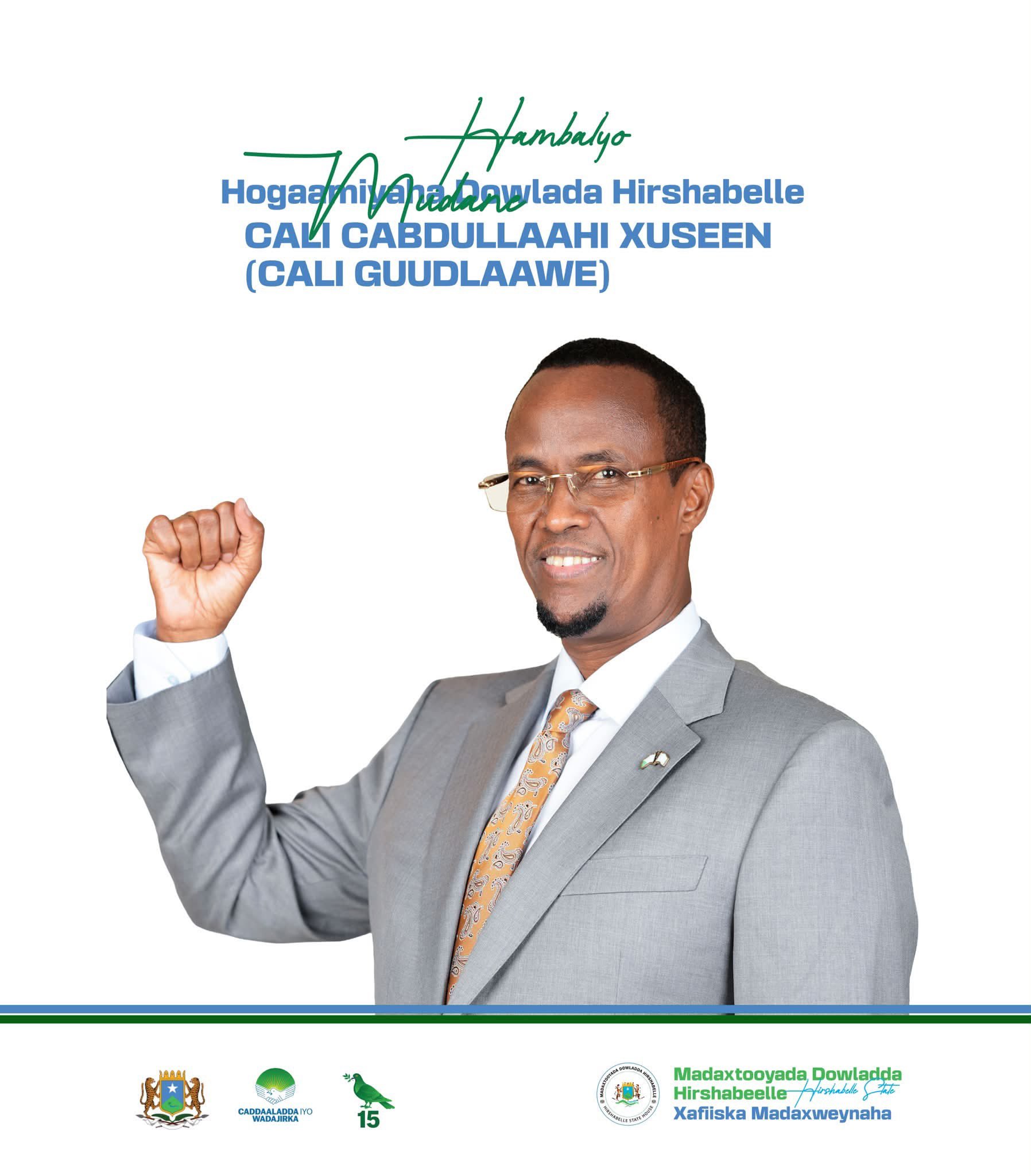
Photo courtesy of President Guudlaawe’s official X (formerly Twitter) account
MOGADISHU, Somalia — October 24, 2026 — The re-election of Ali Guudlaawe as President of Hirshabelle on October 24 represents more than the continuation of an incumbent regional administration. It marks another significant stage in the consolidation of the Justice and Solidarity Party (JSP), led by President Hassan Sheikh Mohamud, across Somalia’s federal political institutions. Coming weeks after direct parliamentary elections in Hirshabelle and Galmudug delivered substantial majorities to the governing party, the outcome illustrates how regional electoral processes are reshaping the distribution of political power ahead of Somalia’s scheduled federal elections in 2027. More fundamentally, it raises a recurring question in Somali federalism: whether political alignment between Mogadishu and federal member states strengthens cooperative governance or gradually concentrates authority within the federal governing coalition.
Former Hirshabelle President Ali Guudlaawe secured re-election with 81 votes in the 99-member state parliament, defeating Nur Ilmi Halane, who received 13 votes, while four ballots were declared invalid. Abdifatah Hassan Afrah was elected vice-president. The outcome followed the September 30 parliamentary elections, in which the Justice and Solidarity Party (JSP) secured 78 of 99 seats, establishing a decisive legislative majority that paved the way for Guudlaawe’s return to power. Although citizens directly elected their parliamentary representatives, the subsequent presidential election was determined by those legislators, illustrating how JSP’s electoral dominance translated into control of the state executive.
The September elections marked a significant departure from the indirect arrangements that have historically shaped Somali state politics. In Hirshabelle, voting took place across ten districts, with 114,633 parliamentary ballots reportedly cast. JSP also secured a majority of local council seats, extending its institutional presence beyond the state legislature. In neighbouring Galmudug, the party won 67 of 89 parliamentary seats. Combined, JSP now holds 145 of the 188 seats across the two states, approximately 77 percent, establishing substantial legislative representation in both administrations. These figures demonstrate the party’s electoral strength within participating districts, although they do not necessarily reflect equivalent levels of popular support across the entire populations of the two states, as reported by Hiiraan Online.
The significance of these developments becomes clearer when compared with the approach pursued by former President Mohamed Abdullahi Farmaajo. During his presidency, federal influence over regional administrations was largely exercised through political negotiations, alliances with selected elites and contested indirect leadership elections. The 2018 South West State election and the 2020 political transitions in Galmudug and Hirshabelle generated accusations of federal interference, contributing to tensions between Mogadishu and regional political actors. Farmaajo’s administration defended its engagement as necessary for national coordination, while opponents viewed it as an attempt to subordinate regional political authority to the federal presidency. These disputes contributed to the deterioration of federal-state relations during the 2021–2022 national electoral crisis, as documented in analyses by the International Crisis Group.
President Hassan Sheikh Mohamud’s administration is pursuing a different institutional approach toward an overlapping political objective: securing cooperation and alignment across federal member states. Rather than relying primarily on negotiated support from indirectly selected regional legislatures, JSP has established parliamentary majorities through direct elections under the revised constitutional and electoral framework. Those majorities have subsequently translated into executive leadership. Where federal political influence during Farmaajo’s presidency depended heavily on elite bargaining and shifting alliances, Hassan Sheikh’s administration is increasingly operating through party structures, electoral institutions and legislative majorities. This creates an institutional advantage extending beyond individual regional leaders, providing organized political networks, local government representation and administrative coordination ahead of the 2027 federal elections.
Yet this change in electoral mechanisms does not necessarily resolve the underlying tensions of Somali federalism. Political alignment can facilitate cooperation on security, development and public administration, but it also raises questions about the independence of regional institutions when the same party dominates the executive, legislature and local councils. Somalia’s federal system is intended to distribute authority between Mogadishu and its member states, regardless of the political affiliations of their leaders. Consequently, the central issue is not simply whether regional governments support the federal administration, but whether they retain the constitutional autonomy to pursue different political positions when their interests diverge.
Despite Guudlaawe’s parliamentary victory, Hirshabelle continues to face unresolved disagreements over political representation between Hiiraan and Middle Shabelle. Since the state’s establishment in 2016, its leadership arrangements have been shaped by negotiations among communities seeking representation within the regional government. Some Hawadle political and traditional leaders maintain that the presidency should rotate to Hiiraan, arguing that Guudlaawe’s continued leadership undermines the political understanding on which the state was established. The election of Abdifatah Hassan Afrah as vice-president provides Hiiraan representation within the executive but does not necessarily resolve demands for the presidency itself. These disagreements have featured in reporting by Hiiraan Online.
This exposes a distinction between electoral legitimacy and political accommodation. Direct elections provide citizens with greater participation in selecting representatives, but parliamentary majorities cannot automatically settle historical disputes over power-sharing. Hirshabelle may therefore possess a formally elected legislature and executive while continuing to confront political grievances among communities that question the distribution of authority. For Guudlaawe, the challenge extends beyond securing parliamentary support to building a workable political settlement across both regions, particularly where security, reconciliation and local governance depend on cooperation among competing political and traditional authorities.
The wider significance of Hirshabelle’s election lies in its timing. On October 15, the National Independent Electoral and Boundaries Commission announced April 15, 2027, for federal parliamentary elections and May 15 for the presidential election. The commission’s timetable includes political party and voter registration beginning in November 2026, making the elections in Hirshabelle and Galmudug important early applications of the party-based model the federal government intends to extend nationally, according to Hiiraan Online.
For Hassan Sheikh’s administration, the implications extend beyond securing politically aligned regional presidents. JSP now possesses substantial representation within state legislatures, local councils and executive institutions, providing an organizational presence that can support political mobilization and coordination during the federal electoral transition. This differs from the environment faced by Farmaajo, whose administration entered the 2021–2022 electoral crisis dependent on agreements among regional leaders and indirectly selected parliamentary representatives. Nevertheless, the experience of both administrations demonstrates that federal-state alignment remains politically consequential, regardless of whether it is achieved through negotiated alliances or party-based electoral competition.
The transition also faces significant political limitations. Puntland and Jubbaland continue to dispute the federal government’s constitutional amendments and electoral arrangements, while opposition groups have questioned the inclusiveness and legality of the revised framework. Their objections demonstrate that Somalia’s electoral disagreement extends beyond the principle of direct voting to the constitutional rules governing elections, the independence of electoral institutions and the distribution of authority within the federation. Successful elections in Hirshabelle and Galmudug therefore establish important administrative precedents but cannot alone resolve disagreements among federal stakeholders over the legitimacy of the national electoral transition.
Furthermore, the scale of participation requires careful interpretation. Across Hirshabelle and Galmudug, approximately 264,108 parliamentary ballots were reportedly cast, including 114,633 in Hirshabelle and 149,475 in Galmudug. These figures represent participation in the districts where voting occurred, rather than the preferences of all eligible citizens across both states. Similarly, JSP’s approximately 77 percent share of combined parliamentary seats should not be interpreted as an equivalent share of the total electorate. The distinction matters when assessing whether regional electoral outcomes provide a representative foundation for broader national political claims.
Ultimately, Hirshabelle’s election illustrates both the opportunities and contradictions of Somalia’s emerging electoral order. The shift from indirect selection toward direct parliamentary voting represents a significant institutional development, while the resulting concentration of political authority within JSP demonstrates how electoral reform can simultaneously strengthen party-based governance and reshape federal-state relations. For Hassan Sheikh Mohamud, the elections in Hirshabelle and Galmudug have created an institutional foundation for political coordination ahead of 2027. For Somalia’s constitutional system, however, the more consequential test is whether this emerging arrangement can accommodate opposition participation, preserve regional autonomy and produce electoral outcomes accepted beyond the governing coalition.
The central political paradox is that Somalia may be moving away from the elite bargains that characterized Farmaajo’s presidency without necessarily escaping the struggle over federal political control. The mechanisms have changed—from negotiated regional alliances to party-based electoral majorities—but the fundamental question remains whether the electoral system will distribute political authority more broadly or consolidate it within the institutions of the governing party. The credibility of the 2027 elections will depend not simply on the number of elections conducted, but on whether the emerging political order can reconcile electoral participation with constitutional legitimacy, federal autonomy and meaningful political competition.