The Somali Monitor
Hassan Sheikh Confronts the UAE: Sovereignty or Political Crisis?
President Hassan Sheikh Mohamud's televised accusations against the UAE have intensified Somalia's diplomatic confrontation at a time of deepening constitutional disputes, electoral uncertainty and strained federal-regional relations. While the UAE contributed just $11.06 million—2.1% of Somalia's recorded external grants in 2025—official budget reports confirm that reversals of Emirati funding commitments affected bilateral financing in 2026. The dispute extends beyond financial assistance to foreign influence over strategic ports, security structures and regional administrations. Ultimately, the confrontation raises a fundamental question: can Somalia effectively defend its sovereignty against external interference while its own constitutional legitimacy, political cohesion and institutional authority remain contested?
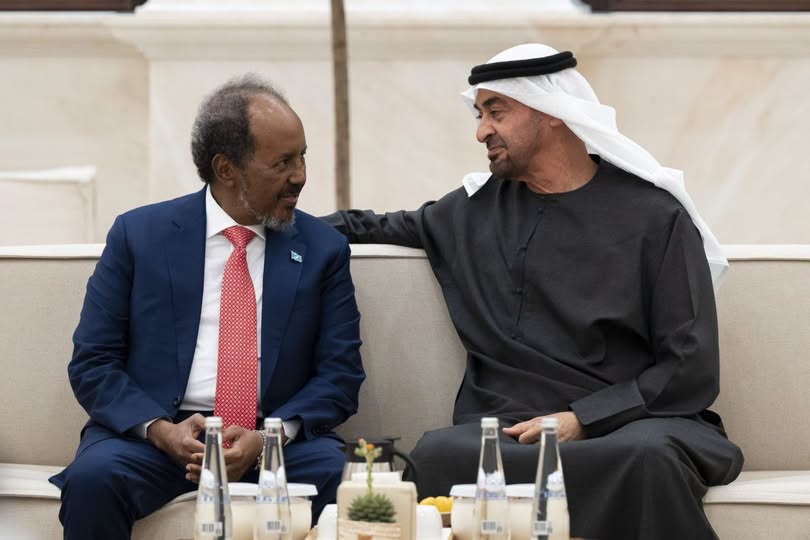
Mogadishu - 17 Nov 2026- President Hassan Sheikh Mohamud's nationally televised address on 17 November 2026 marked a significant escalation in Somalia's deteriorating relationship with the United Arab Emirates (UAE). In unusually direct language, the President accused Abu Dhabi of interfering in Somalia's internal affairs, financing political divisions, supporting security structures outside federal authority and pursuing strategic interests through agreements with regional administrations without Mogadishu's consent. He presented these activities as threats to Somalia's sovereignty, territorial integrity and national unity, drawing parallels with foreign involvement in Libya, Yemen and Sudan.
The President's accusations centred on the UAE's involvement in the strategic ports of Berbera, Bosaso and Kismayo, its security relationships with regional authorities and its alleged role in developments surrounding Somaliland's international recognition. He defended the Federal Government's earlier decision to cancel agreements with Abu Dhabi, insisting that foreign economic and military partnerships must respect Somalia's constitutional order. Despite the severity of his accusations, Hassan Sheikh left open the possibility of restoring relations based on mutual respect and recognition of Somalia's territorial integrity. However, the allegations concerning political financing, parallel security structures and foreign diplomatic interference require independent verification.
The address cannot be understood solely as a bilateral diplomatic dispute. It comes amid unresolved disagreements over constitutional amendments, presidential and parliamentary mandates, electoral arrangements and the distribution of powers between Mogadishu and federal member states. Relations with Puntland and Jubaland remain strained, while opposition figures continue to challenge the government's approach to political transition. Against this backdrop, the President's appeal to national sovereignty intersects with a more immediate question concerning the legitimacy and cohesion of the institutions through which that sovereignty is exercised.
At the centre of the confrontation lies a longstanding weakness in Somalia's federal governance system. While the Federal Government asserts authority over foreign affairs, defence and international agreements, regional administrations have developed external economic and security partnerships reflecting their own political priorities and disagreements with Mogadishu. Puntland and Jubaland have challenged aspects of the Federal Government's constitutional agenda, while Somaliland continues to pursue international recognition. The UAE's relationships with these administrations have consequently become entangled in a wider contest over federal authority, regional autonomy and Somalia's unresolved constitutional settlement.
The strategic ports of Berbera, Bosaso and Kismayo illustrate this contest. Beyond their commercial importance, these facilities occupy strategic positions along maritime routes connecting the Horn of Africa with the Gulf of Aden, Red Sea and Indian Ocean. From Mogadishu's perspective, foreign agreements involving strategic infrastructure without federal oversight risk weakening national authority. Regional administrations, however, have defended such partnerships as opportunities for economic development and investment. The dispute therefore reflects competing interpretations of constitutional authority rather than simply disagreement over foreign commercial influence.
An important dimension of this confrontation concerns the UAE's financial contributions to Somalia's federal budget. According to the Ministry of Finance's 2025 donor figures, Somalia received approximately $515.5 million in external grants, of which the World Bank accounted for $453.78 million, representing 88%. The UAE contributed approximately $11.06 million, or just 2.1% of total recorded grants, while Türkiye provided $7.5 million. Unlike much of the multilateral financing, the UAE's contribution was classified entirely as direct budget support, providing relatively flexible financing for government operations. Historical figures also indicate considerable fluctuations, with Emirati contributions increasing from approximately $9.58 million in 2022 to $38.12 million in 2024 before declining to $11.06 million in 2025.
More significantly, the Federal Government's January–September 2026 Budget Performance Report, published on 31 October, explicitly attributed the underperformance of bilateral budget support to reversals of UAE funding commitments. During the first nine months of 2026, Somalia received only $12 million in bilateral government grants against an annual target of $27 million, representing 44.4% of the planned amount. The report does not specify the precise amount withdrawn by Abu Dhabi or how much of the $12 million received came from the UAE. Nevertheless, it provides documentary evidence that changes in Emirati funding commitments contributed to Somalia's bilateral financing shortfall.
These developments occurred amid broader fiscal pressures. By September 2026, government revenue and grants had reached $619.24 million against an annual target of approximately $1.36 billion, while expenditure stood at $694.21 million, producing a fiscal deficit of $74.98 million. External grants reached only 35.8% of their annual target, reflecting delayed donor disbursements and weak project implementation. The UAE funding reversal was therefore one identifiable element of a wider fiscal challenge, rather than the principal explanation for Somalia's budgetary difficulties. The figures nevertheless expose a distinction between financial dependence and political influence: Abu Dhabi's direct contributions to the federal treasury are comparatively limited, but its commercial, security and regional relationships extend beyond conventional budgetary assistance.
The security dimension is potentially more consequential. The UAE has historically supported military training, equipment and security institutions in Somalia, while also maintaining relationships with regional authorities. Such arrangements raise questions about national command structures, accountability and the extent to which foreign-supported forces operate within an agreed security framework. Yet Somalia's security fragmentation cannot be attributed exclusively to external interference. It also reflects unresolved federal arrangements, competing political authorities and incomplete integration of regional forces into national institutions. Addressing these weaknesses requires transparent security agreements and negotiated institutional reforms rather than diplomatic confrontation alone.
The timing of the address is particularly significant. Hassan Sheikh spoke amid continuing controversy over the Supreme Court, the dismissal of its Chief Justice and the November 5 ruling concerning presidential and parliamentary mandates. These developments have intensified disagreements over constitutional legitimacy and the electoral transition, while planned political consultations have encountered resistance from opposition stakeholders. The President's emphasis on foreign interference therefore invites competing interpretations. Supporters may regard the address as a necessary defence of national sovereignty, while critics may question whether it also seeks to reinforce presidential authority amid mounting domestic political challenges. Neither interpretation can be established solely from the speech, but the political context makes both relevant to understanding its significance.
The deeper contradiction concerns the relationship between national sovereignty and constitutional legitimacy. The Federal Government has a responsibility to protect Somalia's territorial integrity and regulate foreign relations, but sovereignty belongs to the Somali state and its people rather than to any individual administration. Its exercise must therefore be grounded in constitutional accountability, legitimate institutions and political consensus. Disagreements over electoral arrangements, constitutional amendments and federal powers cannot automatically be characterised as foreign-sponsored interference. Equally, legitimate political opposition does not justify unlawful external involvement in national affairs. Distinguishing between these issues is essential to preserving both sovereignty and democratic accountability.
The wider geopolitical context further complicates Somalia's position. The UAE, Türkiye, Egypt and other external partners maintain economic, diplomatic and security interests in the Horn of Africa, reflecting the region's growing strategic importance. These relationships offer opportunities for investment and institutional development but also expose Somalia to competing external interests. Replacing one foreign partner with another would not resolve the underlying vulnerabilities. What is required is a transparent national framework governing foreign military cooperation, strategic infrastructure, external financing and federal-regional consultation.
Ultimately, Hassan Sheikh's November 17 address exposes a fundamental tension in Somalia's state-building process. The President is demanding international respect for the sovereignty of a state whose constitutional arrangements, political authority and security institutions remain deeply contested. His concerns about foreign interference warrant serious examination, while the government's own financial records demonstrate that deteriorating relations with Abu Dhabi have also carried fiscal consequences. The confrontation is therefore simultaneously diplomatic, political, institutional and economic.
The central question is not simply whether Hassan Sheikh's confrontation with the UAE represents a defence of Somali sovereignty or a political response to a deepening domestic crisis. It is whether his administration can address both challenges without allowing one to overshadow the other. Somalia's sovereignty requires protection from external interference, but it also depends on constitutional legitimacy, accountable institutions, predictable public finances and political consensus among its federal stakeholders. Without these foundations, diplomatic confrontation may assert the authority of the state without necessarily strengthening its institutions.