The Somali Monitor
The Hassan-Hamza Political Alliance in Somalia: Executive Stability or Presidential Dominance?
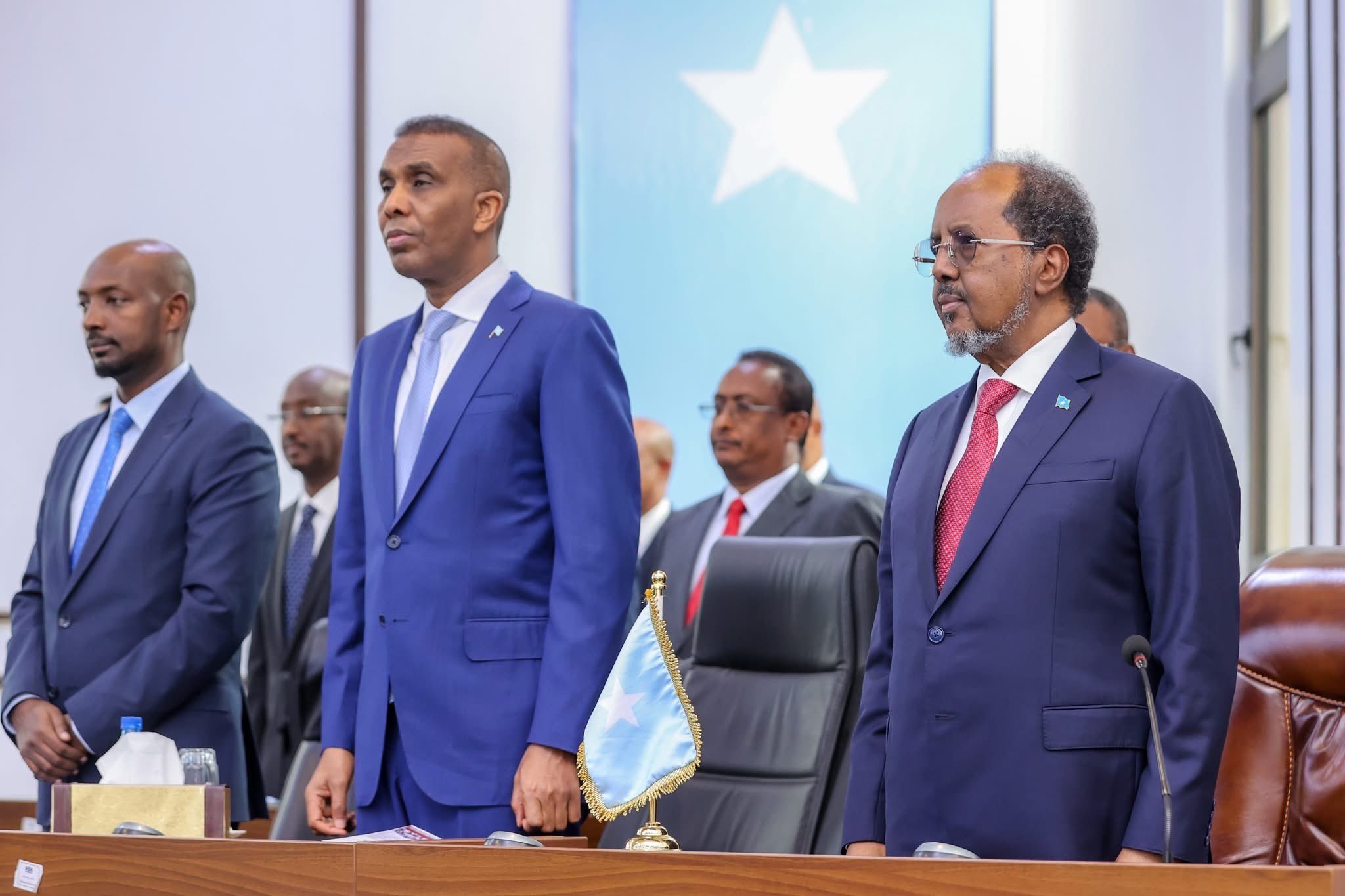
Prime Minister Hamza Abdi Barre’s political alliance with President Hassan Sheikh Mohamud has brought unusual stability to Somalia’s two highest executive offices, facilitating greater political coordination and continuity in constitutional and electoral reforms, economic recovery, security operations, public administration and broader state-building efforts. Yet, amid deepening constitutional disputes and federal-state tensions, questions surrounding the Prime Minister’s political independence raise a fundamental concern: whether their partnership is strengthening Somalia’s institutions or primarily consolidating presidential authority.
Villa Somalia
Since his appointment in June 2022, Prime Minister Hamza Abdi Barre has emerged as one of the most enduring political figures in Somalia's contemporary federal leadership. Barre's premiership has been defined by an unusually stable working relationship with President Hassan Sheikh Mohamud, whose return to office for his second-term presidency, in May 2022. Prime Minister Barre was brought from parliamentary politics, representing Jubbaland into the leadership of the Federal Government. Unlike several of his predecessors whose relationships with presidents deteriorated into institutional confrontation, Barre has maintained close political alignment with Mohamud, and has defended the government's agenda on the current constitutional changes, federal outreach, relations with the member states, security and economic reforms, amid increasingly contentious electoral and constitutional debates.
Barre's rise to national leadership was rooted in a political relationship established well before his appointment. Born around early 1970s and associated with the Ogaden community of the Darood clan family, he developed his professional background in education at national and sub-national level including involvement in establishing Kismayo University. Besides institutional development, Barre's subsequent political career included leadership within the Peace and Development Party, associated with Hassan Sheikh Mohamud, and participation in Jubaland's electoral institutions. These experiences placed him at the intersection of party politics, regional governance and Somalia's emerging federal system, while his longstanding association with Mohamud made him a politically trusted candidate for the premiership. Independent accounts describe a long-standing political partnership between Hamza Abdi Barre and Hassan Sheikh Mohamud that dates back more than a decade, beginning in the early 2010s. During Hassan Sheikh Mohamud’s first presidential term, the two worked closely together, including through the Peace and Development Party (later the Union for Peace and Development), where Barre served as secretary-general between 2011-2017.
Therefore, Barrre’s appointment was more than a conventional exercise in political or even clan balancing. It represented a deliberate preference for an established political ally capable of advancing the President's programme without the internal rivalry that had repeatedly disrupted previous Somali administrations. This arrangement has become one of the defining characteristics of the current government, raising the question of whether personal political compatibility can provide the foundations for lasting institutional stability.
The Hassan–Hamza Alliance: A Departure from Somalia's History of Executive Rivalry
Somalia's federal political history has been marked by recurring confrontations between presidents and prime ministers, often reflecting competing political alliances, struggles over ministerial appointments and disagreements about constitutional authority. During Hassan Sheikh Mohamud's first presidency, Prime Minister Abdi Farah Shirdon was removed through a parliamentary vote of no confidence in December 2013, while his successor, Abdiweli Sheikh Ahmed, was similarly dismissed in December 2014 following disagreements with the President. Under President Mohamed Abdullahi Farmaajo, the relationship with Prime Minister Hassan Ali Khaire ended in his controversial parliamentary removal in July 2020, while subsequent tensions with Prime Minister Mohamed Hussein Roble contributed to the political crisis surrounding the delayed 2021–2022 elections.
Against this background, the Barre–Mohamud partnership represents a significant departure. Their political understanding has largely prevented the competing centres of executive authority that previously paralyzed cabinet operations and diverted government attention towards internal political survival. Barre has publicly emphasized the importance of their longstanding relationship and shared political vision, presenting executive cooperation as an essential condition for delivering government priorities. Their alliance has allowed the administration to maintain continuity across major reforms without the repeated restructuring of political leadership that characterized earlier governments.
Yet the very stability that distinguishes their relationship also invites a different institutional interpretation. Somalia's Prime Minister is constitutionally responsible for leading the Federal Government, coordinating ministries and overseeing the implementation of national policies. A productive relationship with the President can strengthen these functions, but excessive political dependence may diminish the premiership's capacity to exercise independent judgment. The central question is therefore whether Barre's political loyalty has reinforced executive effectiveness or contributed to a system in which presidential preferences increasingly determine the direction of government.
Key Outcomes of the Political Alliance
Beyond the political relationship with Mohamud, Barre's tenure has coincided with important achievements in Somalia's economic recovery and institutional reform. Most notably, Somalia reached the Heavily Indebted Poor Countries (HIPC) Completion Point in December 2023, securing substantial external debt relief and restoring access to international development financing. Although this achievement resulted from reforms pursued across successive administrations, its completion under the current government provided an important foundation for the post-debt-relief economic agenda. Subsequent IMF-supported reforms have focused on domestic revenue mobilization, public financial management, expenditure discipline and financial-sector oversight. The IMF's October 2026 assessment projected economic growth of 2.3 percent for the year, while warning that reduced foreign assistance, climate shocks and regional instability continued to threaten recovery.
Barre's government has also promoted the National Transformation Plan 2025–2029, intended to connect macroeconomic stabilization with longer-term development priorities, including economic diversification, employment, public services, governance and climate resilience. The plan represents an attempt to move Somalia beyond short-term humanitarian and recovery interventions towards more integrated national development planning. However, its implementation remains constrained by limited domestic resources, uneven administrative capacity and the continuing dependence of public institutions on international assistance. The deeper challenge is whether improved macroeconomic indicators and ambitious development frameworks can produce measurable improvements in citizens' livelihoods and public services.
Public administration reform has been another prominent feature of Barre's leadership. In September 2026, he directed federal institutions to introduce competitive, merit-based recruitment for senior civil service positions, beginning with departmental directors. The initiative sought to strengthen professional standards and reduce political influence over appointments, but it encountered immediate parliamentary opposition. On September 23, the House of the People voted 136–2 to overturn the directive, exposing tensions over the distribution of authority between the executive, Parliament and civil service institutions. Barre has also introduced government-wide performance reviews, including a September 2026 assessment of 25 ministries against agreed annual targets. These initiatives demonstrate an emphasis on administrative accountability, although their lasting value depends on institutional enforcement rather than executive directives alone.
Security and stabilization have similarly remained central to the administration's priorities. Barre has supported the strengthening of national security institutions, including training initiatives involving the Somali National Army, Danab special forces and the National Intelligence and Security Agency. His government has also emphasized counter-extremism, community reconciliation and the restoration of civilian administration in areas affected by Al-Shabaab. Nevertheless, the persistence of insurgent violence and disputes over federal–state security cooperation demonstrate that strengthening national forces is only one dimension of stabilization. Lasting security requires political agreements, effective local governance and public institutions capable of sustaining gains beyond military operations.
The Controversies of the present Hassan–Hamza Political Alliance.
The most consequential controversies surrounding Barre's premiership concern constitutional amendments, electoral reforms and the relationship between Mogadishu and the Federal Member States. The government has defended the constitutional process as essential to completing Somalia's institutional transition and replacing indirect elections with broader popular participation. In October 2026, Barre chaired an extraordinary Cabinet meeting approving preparations for legislation defining the structure of government, ministerial responsibilities and the organization of federal institutions. He reiterated the government's intention to implement the revised constitution in stages and pursue federal one-person, one-vote elections in 2027.
However, Puntland, Jubaland and prominent opposition actors have rejected important aspects of the constitutional changes, questioning their legitimacy and the extent of federal consultation. These disagreements have become particularly significant because the constitutional process affects electoral arrangements, executive authority and the distribution of powers between federal and state institutions. Barre's support for the President's approach has placed him at the centre of these disputes, raising questions about whether the premiership has functioned as an independent institution capable of facilitating political compromise or primarily as the mechanism through which the President's constitutional agenda is implemented.
The controversy extends to the relationship between executive stability and institutional checks. In September 2025, Barre's public declaration of loyalty to Mohamud generated competing political interpretations. Supporters viewed his remarks as evidence of political maturity and a welcome departure from destructive executive rivalry. Critics, including members of Parliament, argued that such expressions risked diminishing the independent constitutional standing of the premiership. Barre subsequently emphasized in a September 2026 interview that their cooperation reflected a shared political programme developed before taking office, rather than unquestioning personal obedience. The debate therefore concerns more than political loyalty: it raises the question of whether the Prime Minister's authority derives principally from his constitutional office or from the political confidence of the President.
Leadership, Critics and the Question of Political Independence
Assessments of Barre's leadership reveal two competing interpretations. Supporters regard his premiership as evidence that Somalia can maintain a functioning executive without the recurring political crises that undermined previous administrations. They point to debt relief, continued economic reform, administrative modernization and government continuity as achievements facilitated by a stable presidential–prime ministerial partnership. From this perspective, Barre's willingness to avoid confrontation with Mohamud reflects a pragmatic recognition that political rivalry at the highest levels of government can weaken already fragile institutions.
Critics offer a different assessment. They argue that the absence of executive confrontation should not be confused with the existence of effective institutional checks, particularly when major constitutional decisions remain contested. The Prime Minister's close alignment with Mohamud has raised concerns that the premiership may have limited capacity to mediate between the presidency, Parliament, federal member states and opposition groups. The rejection of his civil service recruitment directive by Parliament also illustrates that executive cooperation does not necessarily translate into wider institutional agreement. These concerns do not establish that Barre lacks independent authority, but they demonstrate why political stability must be evaluated alongside accountability, constitutional legitimacy and the ability to accommodate disagreement.
Barre's political background in Jubaland adds another dimension to this assessment. His emergence from Jubaland's political environment did not prevent the deterioration of relations between the federal government and the state's leadership. This illustrates a fundamental limitation of Somalia's political accommodation arrangements: the presence of a politician from a particular region or clan in national office does not automatically produce institutional agreement with that region. Effective federal leadership requires negotiated relationships between governments, not merely the representation of individuals within the national executive.
What it comes down to, at the end
Hamza Abdi Barre's premiership stands out for its longevity, executive stability and association with significant political, economic and administrative reforms. His partnership with President Hassan Sheikh Mohamud has avoided the repeated confrontations that disrupted previous Somali governments, allowing the administration to pursue a comparatively consistent policy agenda.
Yet this stability has developed alongside deepening constitutional disagreements, contested electoral arrangements and tensions between Mogadishu and Federal Member States. These developments expose the limitations of evaluating government effectiveness through executive cohesion alone. Somalia's central political challenge is not simply whether its President and Prime Minister can work together, but whether their cooperation strengthens institutions capable of accommodating competing interests and sustaining political legitimacy beyond the current administration.
The defining question for Barre is therefore whether his political partnership with Mohamud represents a durable model of institutional cooperation or a form of executive stability dependent on personal loyalty. His legacy will ultimately be measured not only by reforms introduced and policies advanced, but by whether those achievements produce stronger public institutions, meaningful federal cooperation and accountable government.
Somalia's political history demonstrates the costs of presidents and prime ministers working against one another. The Hassan–Hamza partnership demonstrates the potential advantages of their working together. The remaining question is whether that partnership has strengthened the state beyond the two individuals who lead it.