The Somali Monitor
Hassan–Farmaajo Talks: A Breakthrough in Somalia’s Electoral Deadlock?
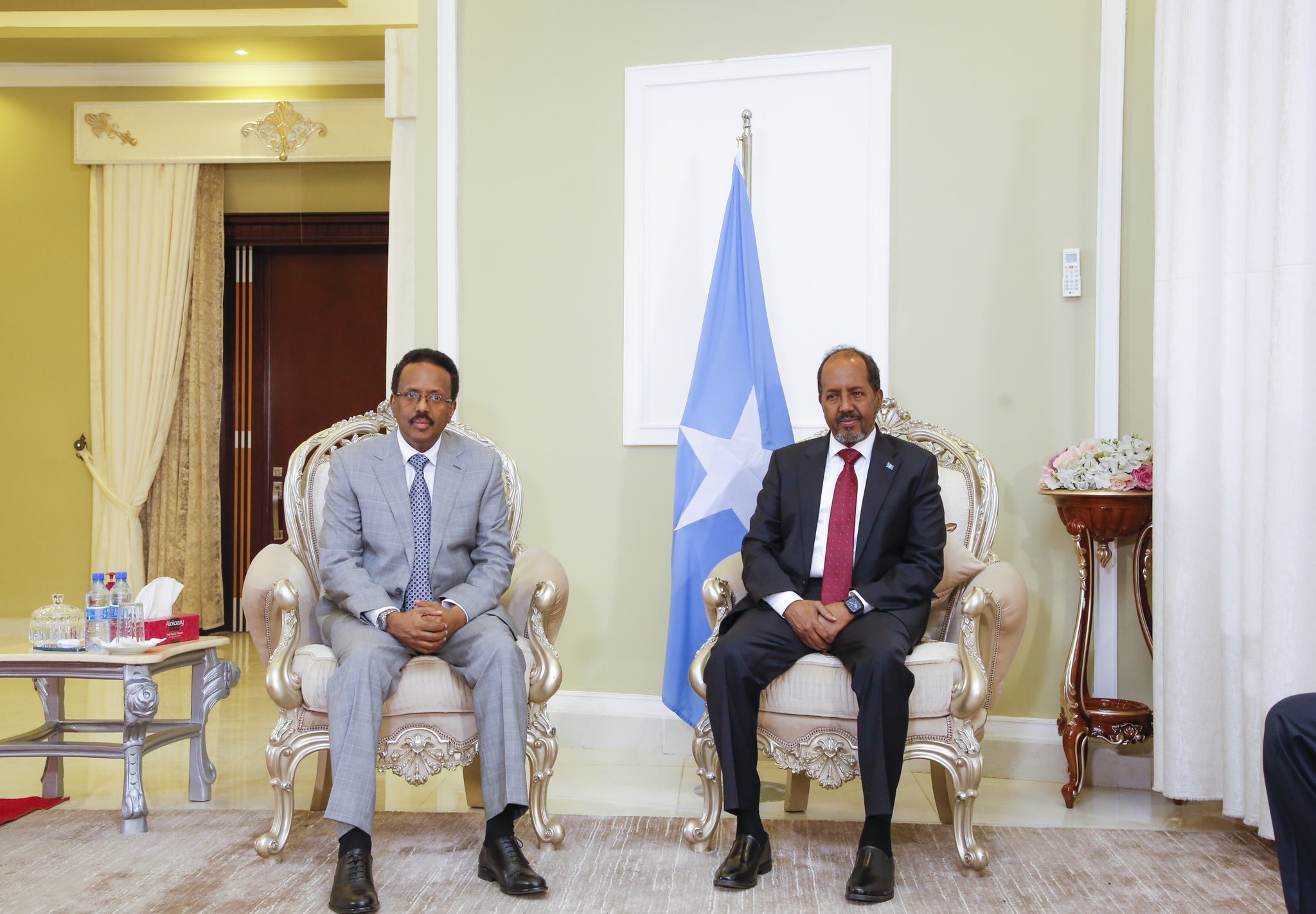
President Hassan Sheikh and former President Farmaajo, May 19, 2026. Photo: Villa Somalia.
MOGADISHU, Somalia — According to confidential information obtained by The Somali Monitor, political engagement is underway between President Hassan Sheikh Mohamud’s administration and former President Mohamed Abdullahi Farmaajo, potentially opening a new avenue for resolving Somalia’s electoral deadlock. Farmaajo, an influential former president from the Marehan clan within the broader Daarood family, retains political significance through his Nabad iyo Nolol movement, constituencies in Jubaland and Galmudug, and longstanding ties with former Southwest State President Abdiaziz Hassan Mohamed Laftagareen. A separate understanding with Hassan Sheikh, even without Puntland President Said Abdullahi Deni, Jubaland President Ahmed Madobe and former President Sharif Sheikh Ahmed, could reshape an already fragmented opposition and provide a breakthrough in the present stalemate. More importantly, if negotiations produce credible electoral guarantees and genuine political competition, they could strengthen the legitimacy of the next federal government, including a possible renewed Hassan Sheikh administration.
The reported engagement involves two parallel tracks: efforts to reach a political understanding with the former President Farmaajo and separate contacts with representatives of Nabad iyo Nolol concerning participation in the national consultations called by President Hassan Sheikh scheduled for November 14–18. On November 1, FTL Somalia reported that National Intelligence and Security Agency Director Mahad Mohamed Salad had met opposition figures in Mogadishu, emphasizing security pressures and the urgency of electoral negotiations. Former Prime Minister Omar Abdirashid Ali Sharmarke reportedly delivered a similar message. These developments follow Hassan Sheikh’s October 26 invitation to Nabad iyo Nolol, the Somali Future Council, the National Unity Forum and civil society representatives. Although the broader outreach is publicly documented, the precise terms of the reported engagement with Farmaajo remain unconfirmed.
Farmaajo’s political significance extends beyond his presidency from 2017 to 2022. His Marehan affiliation connects him to constituencies in Gedo, Jubaland, and other locations in Galmudug. These geographical connections are consequential because Gedo remains politically contested between Mogadishu and Madobe’s administration, while Galmudug’s political leadership has increasingly aligned with the federal government. The European Union Agency for Asylum’s assessment of Gedo documents the Marehan community’s political and territorial significance. Although clan affiliation does not guarantee political loyalty, Farmaajo’s connections across these regions provide him with a constituency extending beyond the capital, Mogadisho.
The influence of the former president Farmaajo also extends through political alliances, particularly with Laftagareen, who assumed the South West State presidency during Farmaajo’s administration in December 2018. Their longstanding relationship remains relevant following Laftagareen’s removal amid the March 2026 confrontation in Baidoa. Reuters reported the federal military takeover and Laftagareen’s resignation, while an October assessment by the Critical Threats Project documented continued activity by forces aligned with him. Although the present political coordination between Farmaajo and Laftagareen has not been independently established, but their relationship goes back to the 2022 elections, illustrating how they are politically aligned. These indications further show Farmaajo’s influence extension, adding another dimension to any agreement with Hassan Sheikh.
Despite belonging to the broader Daarood clan family, Farmaajo, Deni and Madobe do not pursue identical political objectives. Farmaajo’s immediate calculations concern national electoral participation and the political position of Nabad iyo Nolol. Deni, who contested the May 2022 presidential election, retains national presidential ambitions alongside Puntland’s constitutional objections to federal decision-making. Madobe’s priorities are more closely connected to securing recognition of his disputed November 2024 re-election and preserving Jubaland’s autonomy. As Reuters reported in November 2024, Jubaland suspended relations with Mogadishu following the disputed election. These differences demonstrate why shared opposition to Hassan Sheikh does not necessarily translate into a unified negotiating strategy.
The wider opposition faces similar difficulties. Despite agreement over objections to constitutional amendments and the electoral timetable, its leaders have struggled to establish common leadership, consistent negotiating positions or an agreed alternative. Farmaajo’s exclusion from the Somali Future Council illustrates these divisions. In July, Somalia Today reported disagreements among coalition members over his inclusion, while FTL Somalia documented Nabad iyo Nolol’s rejection of proposals for a transitional administration. Even within the Somali Future Council, disagreements over participation in Hassan Sheikh’s consultations have complicated efforts to reach consensus. The opposition’s weakness therefore lies not in the absence of common grievances, but in its inability to translate them consistently into a collective political strategy.
For Hassan Sheikh, this fragmentation creates an opportunity to negotiate separately with influential political actors rather than confront a unified opposition. An understanding with Farmaajo could secure the participation of a former president with national influence, Marehan constituencies in Jubaland and Galmudug, and political relationships extending into South West State. It could also reduce the political pressure to secure simultaneous agreement with Deni, Madobe and Sharif Sheikh Ahmed. However, Farmaajo cannot speak on behalf of those leaders or their constituencies, and his participation would not automatically resolve Puntland’s constitutional disagreements, Jubaland’s contested mandate or South West State’s unresolved political confrontation.
The immediate obstacle remains mutual mistrust. Hassan Sheikh and Farmaajo’s rivalry during the contentious 2021–2022 electoral transition continues to shape the risks of any understanding. Farmaajo would require assurances that participation does not constitute unconditional acceptance of the disputed constitutional amendments, presidential mandate or electoral timetable. Hassan Sheikh, meanwhile, would seek confidence that concessions would lead to meaningful participation rather than continued rejection of the process. Their unequal institutional positions complicate negotiations further: Hassan Sheikh controls the federal executive and institutions implementing the electoral programme, while Farmaajo negotiates from outside government. Without written guarantees, transparent procedures and mutually accepted implementation arrangements, an agreement could remain vulnerable to renewed confrontation.
Nevertheless, a successful understanding could have implications beyond overcoming the immediate deadlock. If Hassan Sheikh secures Farmaajo’s participation through agreed electoral arrangements, it could demonstrate that the transition is becoming a negotiated political contest rather than a process determined exclusively by the incumbent administration. The involvement of a prominent former president and an established opposition movement could strengthen confidence in the electoral framework, even if other influential leaders remain outside the initial agreement. This would represent a meaningful political breakthrough, provided the process allows genuine competition and preserves opportunities for wider participation.
For Hassan Sheikh, the potential benefit could extend to the legitimacy of his next government should he secure another presidential mandate. An election conducted under mutually accepted rules, with meaningful opposition participation and credible institutional safeguards, could provide a stronger democratic basis for his administration than one conducted amid widespread rejection of its procedures. Such legitimacy would not arise simply from Farmaajo’s participation, but from independent electoral administration, transparent implementation, genuine political competition and respect for the outcome. A bilateral agreement could therefore contribute to a more broadly accepted electoral transition without necessarily resolving every constitutional and federal dispute beforehand.
The approaching parliamentary elections scheduled for April 15, 2027, and presidential election for May 15 add urgency to these calculations. Deni’s presidential ambitions, Madobe’s contested Jubaland mandate, Laftagareen’s South West State dispute and Sharif Sheikh Ahmed’s constitutional objections would remain politically consequential even if Farmaajo reaches an agreement. Their continued opposition could complicate national acceptance, particularly if the negotiations exclude opportunities for subsequent participation. Yet the absence of unanimous agreement would not necessarily prevent progress if the resulting framework establishes credible competition and creates avenues for addressing outstanding disagreements.
Ultimately, the reported Hassan Sheikh–Farmaajo engagement could become more than a bilateral political accommodation. Farmaajo’s national standing, regional constituencies, longstanding alliances and independent position within a fragmented opposition make his participation consequential. For Hassan Sheikh, an agreement could provide an opening to overcome the immediate electoral stalemate and strengthen the legitimacy of a government emerging from a credible contest. Although it would not resolve every competing political ambition or federal dispute, a negotiated electoral framework with enforceable guarantees could transform Somalia’s present confrontation into a workable political transition and establish a foundation for broader national accommodation.